
One stop solution for magnetic products
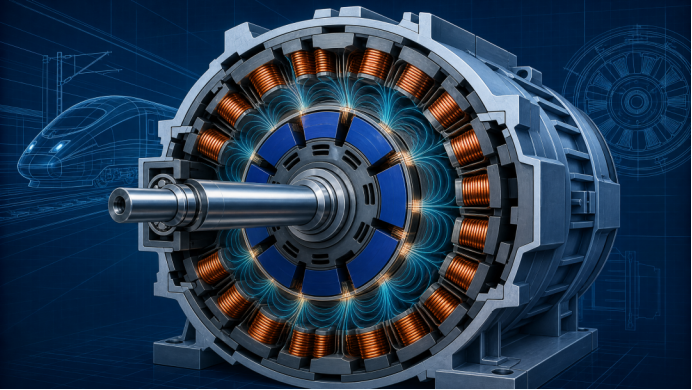
Motors are core power equipment in modern industry, widely used in new energy vehicles, industrial automation, machinery, home appliances and other fields. The two mainstream types on the market are permanent magnet motors and conventional induction excitation motors. They differ greatly in working principle, operating efficiency, cost, size, performance and service life.
With 30 years of experience in R&D and production of permanent magnet materials, our company specializes in customized motor magnets and supporting solutions. This article compares their key differences to help customers select the right motor for various working conditions.
1. Fundamental Difference: Working Principle & Magnetic Field Generation
The way magnetic field is generated is the core distinction, which determines overall motor performance.
· Conventional Motors: Adopt electric excitation. Magnetic field is created by current flowing through windings, with its strength and direction adjusted in real time. Continuous excitation and heat loss during operation lead to low energy efficiency.
· Permanent Magnet Motors: Equipped with high-performance neodymium iron boron, ferrite and other customized permanent magnets. The inherent magnetic field of magnets requires no excitation current, eliminating excitation loss fundamentally. With professional magnetization technology and stable material properties, the motors maintain long-term efficient and reliable operation.
2. Operating Efficiency & Energy Saving
Energy efficiency is the biggest advantage of permanent magnet motors, making them ideal for high-end industrial applications.
· Conventional Motors: Suffering from excitation and heat loss, they deliver low overall efficiency with obvious efficiency fluctuation under variable loads. They are suitable for devices with stable working conditions and low energy-saving requirements, such as ordinary water pumps, general fans and household appliances.
· Permanent Magnet Motors: Free of excitation loss, their overall efficiency is 8%–15% higher than conventional motors. Under low-speed and partial-load conditions, energy savings can reach 20%–30%. Featuring a wide high-efficiency range and low temperature rise, they are widely applied in new energy vehicles, wind power generation, automated equipment and other long-term variable-frequency operating scenarios.
3. Cost & Long-Term Return
From a full-lifecycle perspective, permanent magnet motors offer far better cost performance despite higher initial investment.
· Conventional Motors: Mature manufacturing processes bring low procurement costs, suitable for projects with limited short-term budgets. However, wearable parts like brushes and slip rings require regular inspection and replacement, resulting in high long-term maintenance costs.
· Permanent Magnet Motors: The upfront cost is 30%–50% higher. Featuring a simplified structure with no vulnerable components, they boast a service life 3–5 times longer. Thanks to our precise dimensional tolerance control and stable magnetic performance, maintenance intervals are greatly extended. The electricity saved can offset the initial price gap within 2 to 3 years, bringing superior long-term economic benefits.
4. Size, Weight & Operational Performance
Permanent magnet motors show outstanding strengths in space-limited, high-precision and heavy-load working conditions.
· Conventional Motors: Low power density leads to bulky size and heavy weight. They have low starting torque and slow response, often requiring auxiliary starting devices. They are only applicable to traditional equipment with no strict requirements on space and performance.
· Permanent Magnet Motors: Extremely high power density. For the same power rating, their size and weight are merely 50%–60% of conventional motors. The starting torque reaches 2.5 times the rated value with fast dynamic response, meeting demands for instant heavy-load startup and high-precision operation. They are widely used in CNC machine tools, servo systems, industrial crushing equipment and other high-end facilities.
5. Application Scenarios
Conventional Motors
Cost-sensitive general fields: ordinary fans, water pumps, household appliances, standard machine tools and other equipment with stable loads and low operation frequency.
Permanent Magnet Motors
High-end energy-saving & precision fields: new energy industry, wind power, industrial servo systems, precision CNC equipment, variable-frequency energy-saving devices and other facilities requiring long-term high-efficiency operation.
Conclusion
Conventional motors feature low cost and mature technology for traditional low-end working conditions. Permanent magnet motors excel in energy saving, compact size, long service life and comprehensive benefits, becoming the mainstream trend for industrial motor upgrading and new energy equipment iteration.
Feel free to contact us for customized high-performance permanent magnet accessories for motors.
Search
Categories List
Please give us a message
Beijing Saint Langma Magnetic Technology Co.,Ltd