
One stop solution for magnetic products
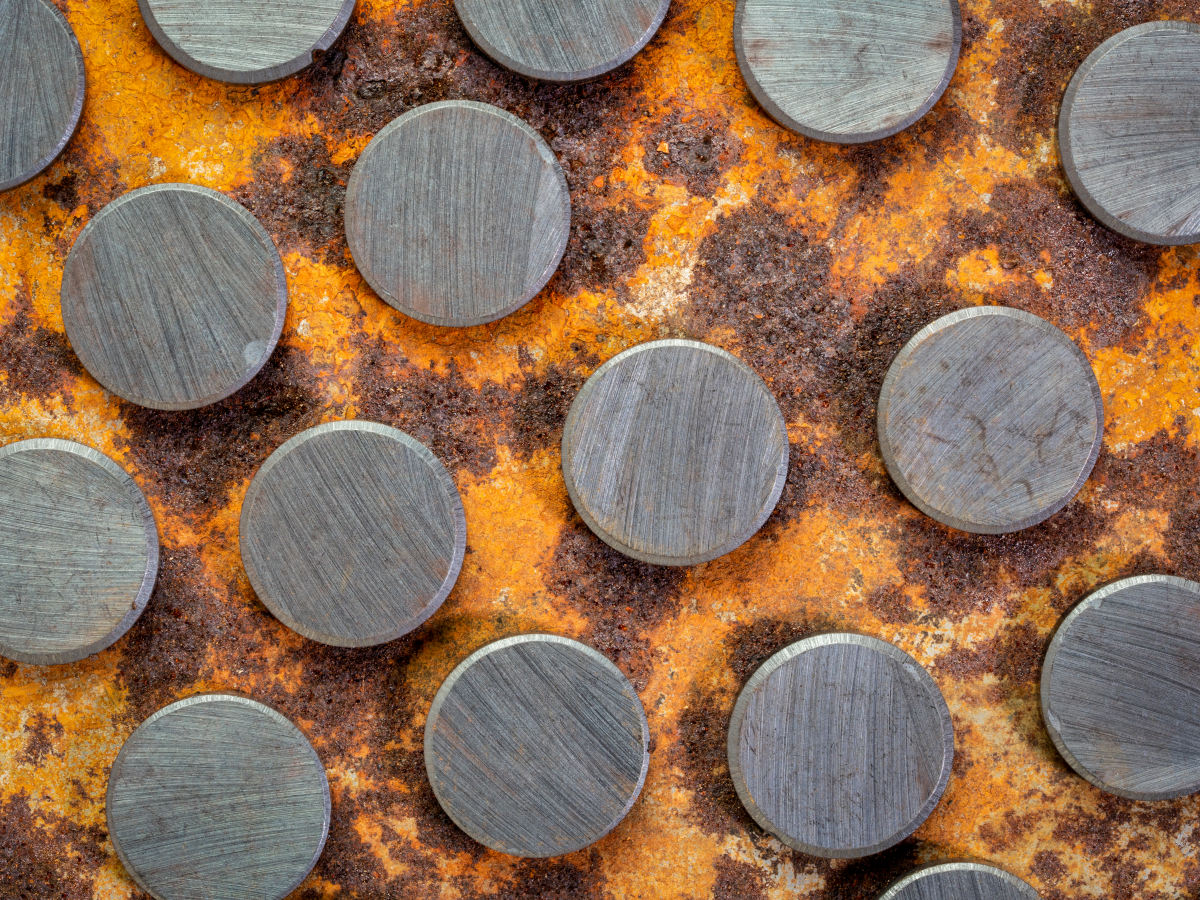
1. What Causes Neodymium Magnet Corrosion?
Material properties and environmental conditions are the two main factors responsible for neodymium magnet corrosion.
1.1 Intrinsic Material Properties: The Root Cause of Interphase Corrosion
Material composition is one of the primary factors contributing to corrosion. Sintered NdFeB magnets have a multiphase microstructure that makes them inherently susceptible to corrosion.
A typical sintered NdFeB magnet consists mainly of three phases:
Main phase (Nd₂Fe₁₄B): Accounts for approximately 84% of the volume and is the primary magnetic phase.
Nd-rich phase (Nd₄Fe): Accounts for approximately 14% and is mainly distributed along the grain boundaries, surrounding the Nd₂Fe₁₄B grains.
B-rich phase (Nd₁₊ₓFe₄B₄): Accounts for approximately 2% and exists as a metastable phase within the microstructure.
The electrochemical potentials of the Nd-rich phase and the main phase differ significantly, with the Nd-rich phase having a more negative potential. When the magnet is exposed to a humid environment, these differences can promote the formation of microscopic electrochemical corrosion cells.
As a result, the Nd-rich phase can corrode preferentially, with corrosion gradually propagating along grain boundaries. Over time, this may cause the magnet to become porous, powdery, or partially detached, ultimately leading to degradation of its mechanical integrity and magnetic performance.
This multiphase structure is one of the key reasons why sintered NdFeB magnets are more corrosion-sensitive than many other permanent magnet materials.
1.2 Environmental Factors: The Combined Effects of Humidity and Corrosive Media
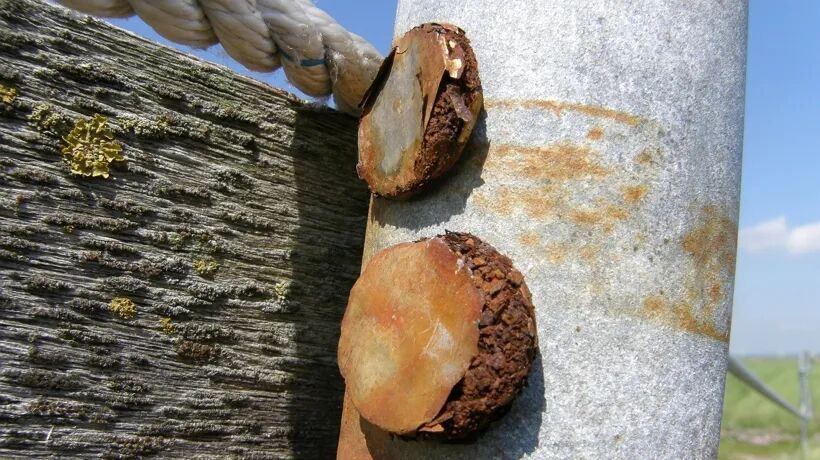
Environmental conditions are another major contributor to neodymium magnet corrosion, particularly temperature, humidity, and exposure to corrosive chemicals.
High humidity is one of the most important triggers of corrosion in NdFeB magnets. Moisture can penetrate surface defects and microscopic pathways associated with the magnet's microstructure, allowing corrosion to develop beneath the surface.
In addition to humidity, different corrosive media can affect NdFeB magnets through different mechanisms. For example:
Hydrochloric acid (HCl): Can strongly attack the Nd-rich phase at grain boundaries, potentially causing a significant reduction in magnetic energy product.
Nitric acid (HNO₃): Can cause substantial damage to the main phase and may reduce the intrinsic coercivity of the magnet.
Phosphoric acid (H₃PO₄) and oxalic acid: Under certain conditions, these acids can contribute to the formation of passive films that may slow down further corrosion.
Therefore, when evaluating the corrosion resistance of a neodymium magnet, it is important to consider not only humidity but also the specific chemical environment in which the magnet will operate.
2. How to Prevent Neodymium Magnets from Rusting
Because untreated NdFeB magnets are highly susceptible to corrosion, proper protection is essential for long-term use. The most effective neodymium magnet rust prevention strategies involve surface coatings, environmental control, careful handling, and proper storage.
2.1 Surface Coatings and Plating
Surface treatment is one of the most important methods of protecting NdFeB magnets against corrosion. Most sintered NdFeB magnets used in industrial applications are supplied with some form of protective coating.
Common options include nickel, zinc, epoxy, and other specialized surface treatments.
Among them, Ni-Cu-Ni (nickel-copper-nickel) is one of the most widely used solutions. The multilayer structure creates a protective barrier between the magnet substrate and the surrounding environment, helping to reduce exposure to moisture and corrosive substances.
For applications involving high humidity or severe salt spray, epoxy and other specialized coatings may provide additional protection depending on the operating conditions.
When selecting a neodymium magnet coating, buyers and engineers should consider more than just the appearance of the surface. Important factors include coating type, coating thickness, adhesion, surface integrity, and corrosion-resistance testing such as salt spray testing.
The appropriate coating should always be selected according to the actual operating environment and expected service life.
2.2 Control the Operating Environment
Whenever possible, avoid exposing NdFeB magnets directly to high humidity, water vapor, or corrosive substances.
If moisture exposure cannot be avoided, additional protection may be required, such as:
Waterproof housings, Sealed assemblies, Encapsulation, Protective barriers, Moisture-resistant packaging
During storage, neodymium magnets should be kept in a dry and well-controlled environment. For long-term storage, sealed packaging combined with desiccants can help reduce moisture exposure and lower the risk of corrosion.
2.3 Handle and Assemble Magnets Carefully
Damage to the protective coating can significantly increase the risk of corrosion.
During machining, transportation, and assembly, magnets should be protected against impact, scratching, and chipping. Even a small defect in the coating can expose the underlying NdFeB material to moisture and corrosive substances.
This is particularly important around edges, corners, and other areas that are more vulnerable to mechanical damage.
During assembly, operators should handle magnets carefully and avoid dragging or striking them against metal surfaces. If serious coating damage is identified, the magnet should be evaluated and, when necessary, replaced or recoated before being put into service.
By combining appropriate surface protection, environmental control, and careful handling, the risk of neodymium magnet rust can be significantly reduced, allowing NdFeB magnets to deliver stable performance over a longer service life.
3. How Does NdFeB Compare with Other Permanent Magnets?
Although neodymium magnets offer some of the highest magnetic performance among commercially available permanent magnets, their corrosion resistance is not their strongest advantage.
Compared with other common permanent magnet materials, sintered NdFeB is generally more sensitive to moisture and corrosion.
3.1 Sintered NdFeB Magnets
Sintered NdFeB magnets offer extremely high magnetic performance and excellent size-to-performance ratios. However, their corrosion resistance is relatively limited.
Without appropriate surface protection, untreated NdFeB magnets can corrode rapidly in humid or corrosive environments. For this reason, protective coatings are commonly used in industrial applications.
3.2 Sintered SmCo Magnets
Sintered SmCo magnets offer excellent temperature stability and significantly better corrosion resistance than NdFeB in many applications.
In some environments, SmCo magnets can be used without a protective coating. They can also withstand higher operating temperatures than standard NdFeB grades.
However, SmCo magnets generally cost more than NdFeB magnets, and their maximum magnetic energy product is typically lower than that of the highest-performance NdFeB grades.
3.3 Sintered Ferrite Magnets
Sintered ferrite magnets are primarily based on iron oxide materials and offer excellent environmental stability and corrosion resistance.
They are relatively inexpensive and can be suitable for outdoor or demanding environments where extremely high magnetic performance is not required.
However, their magnetic performance is significantly lower than that of NdFeB magnets. As a result, a larger magnet volume may be required to achieve the desired magnetic force.
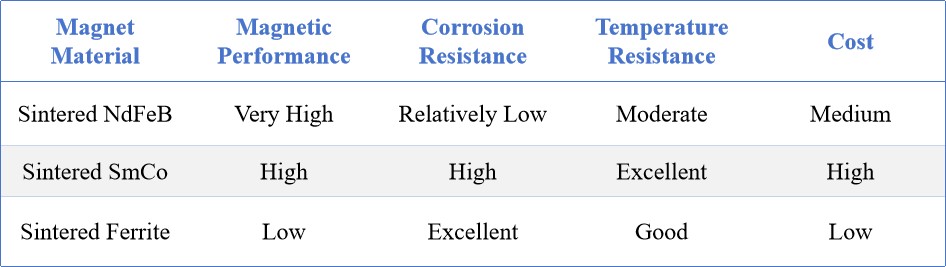
The comparison above shows that the exceptional magnetic performance of NdFeB magnets comes with a vulnerability to corrosion. In applications that require extremely high magnetic strength, such as new energy motors, wind turbines, and medical equipment, NdFeB magnets are often the preferred choice, but proper rust prevention and corrosion protection are essential. In extremely humid environments or applications where exceptionally high reliability is required, engineers may consider replacing NdFeB with more corrosion-resistant permanent magnet materials, such as SmCo magnets, when slightly lower magnetic performance is acceptable.
For industrial engineers and magnet buyers, the key is to select the right permanent magnet material based on the operating environment and ensure that the supplier provides a reliable corrosion protection solution. If you have any questions about NdFeB magnet selection, coating processes, or alternative materials such as SmCo magnets, feel free to consult a professional magnet supplier for expert advice.
Search
Categories List
Please give us a message
Beijing Saint Langma Magnetic Technology Co.,Ltd