
Complete product specifications
Support customization
PRODUCTS
MESSAGE
Magnetism, Magnetic Field, and Magnetic Force: 9 Key Concepts
A magnet on your refrigerator, the magnetic mount on the back of your phone, the snap of an earbud case closing. Magnetism is one of the most familiar physical phenomena in everyday life.
We often say a magnet is “strong,” that it “pulls hard,” or that there’s “a magnetic field” nearby. In everyday conversation, those phrases are easy enough to understand.
But are magnetism and magnetic force the same thing? What is the relationship between a magnet and its magnetic field? Can any material that sticks to a magnet be made into a permanent magnet?
These questions sound simple. The terms, however, describe different things. Some refer to material properties, others to fields in space or forces between objects, and still others to engineering design.
1. Nine Key Concepts at a Glance
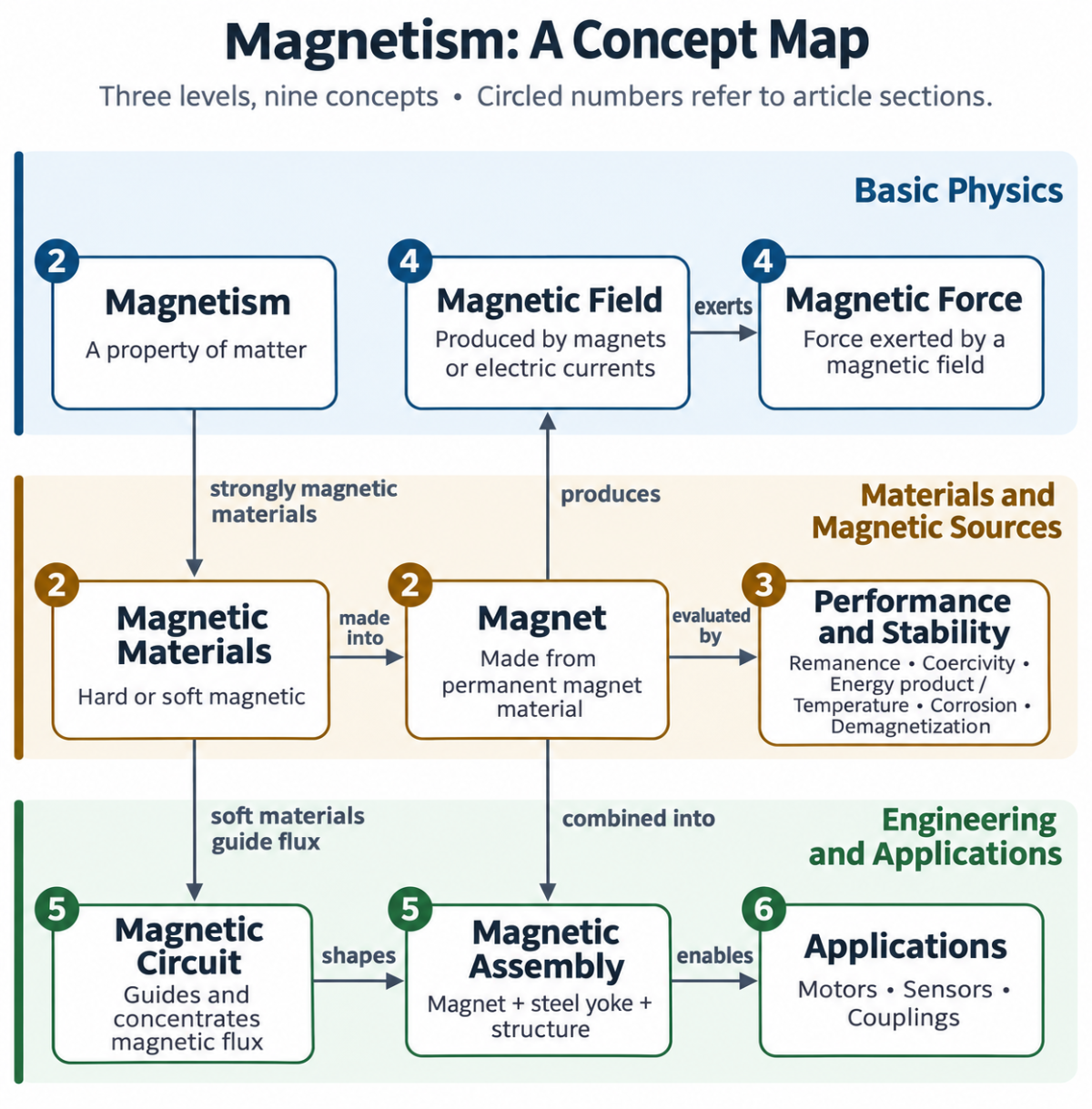
The diagram groups nine common concepts into three categories:
- Basic physics: magnetism, magnetic field, and magnetic force
- Materials and magnetic sources: magnetic materials, magnets, and magnet performance and stability
- Engineering and applications: magnetic circuits, magnetic assemblies, and applications of magnetism
These concepts are connected. Materials with useful magnetic properties can serve as magnetic materials in engineering. A magnet creates a magnetic field, which can exert a force on an object. Engineers combine magnets with materials that guide magnetic flux to design magnetic circuits and build assemblies for specific applications.
2. Magnetism, Magnetic Materials, and Magnets
Magnetism is a property of matter that arises from electrons, primarily from their spin. All materials respond to a magnetic field to some degree, but the strength of that response varies widely. In iron, cobalt, nickel, and some of their alloys and compounds, atomic magnetic moments spontaneously align within small regions called magnetic domains. This can produce a strong magnetic response. In copper, aluminum, and water, the response is generally too weak to notice in everyday life.
In engineering, magnetic materials are materials with useful magnetic properties. Two common categories are:
- Hard magnetic materials, also called permanent magnet materials, retain their magnetization after being magnetized. They are used to make permanent magnets. Common examples include neodymium iron boron (NdFeB), samarium cobalt (SmCo), alnico, and hard ferrite.
- Soft magnetic materials are easy to magnetize and demagnetize. They guide magnetic flux in components such as motor cores, transformer cores, and magnetic yokes. Common examples include pure iron, low-carbon steel, electrical steel, soft ferrite, and permalloy.
Here, hard and soft describe magnetic behavior. The diagram below illustrates the difference.
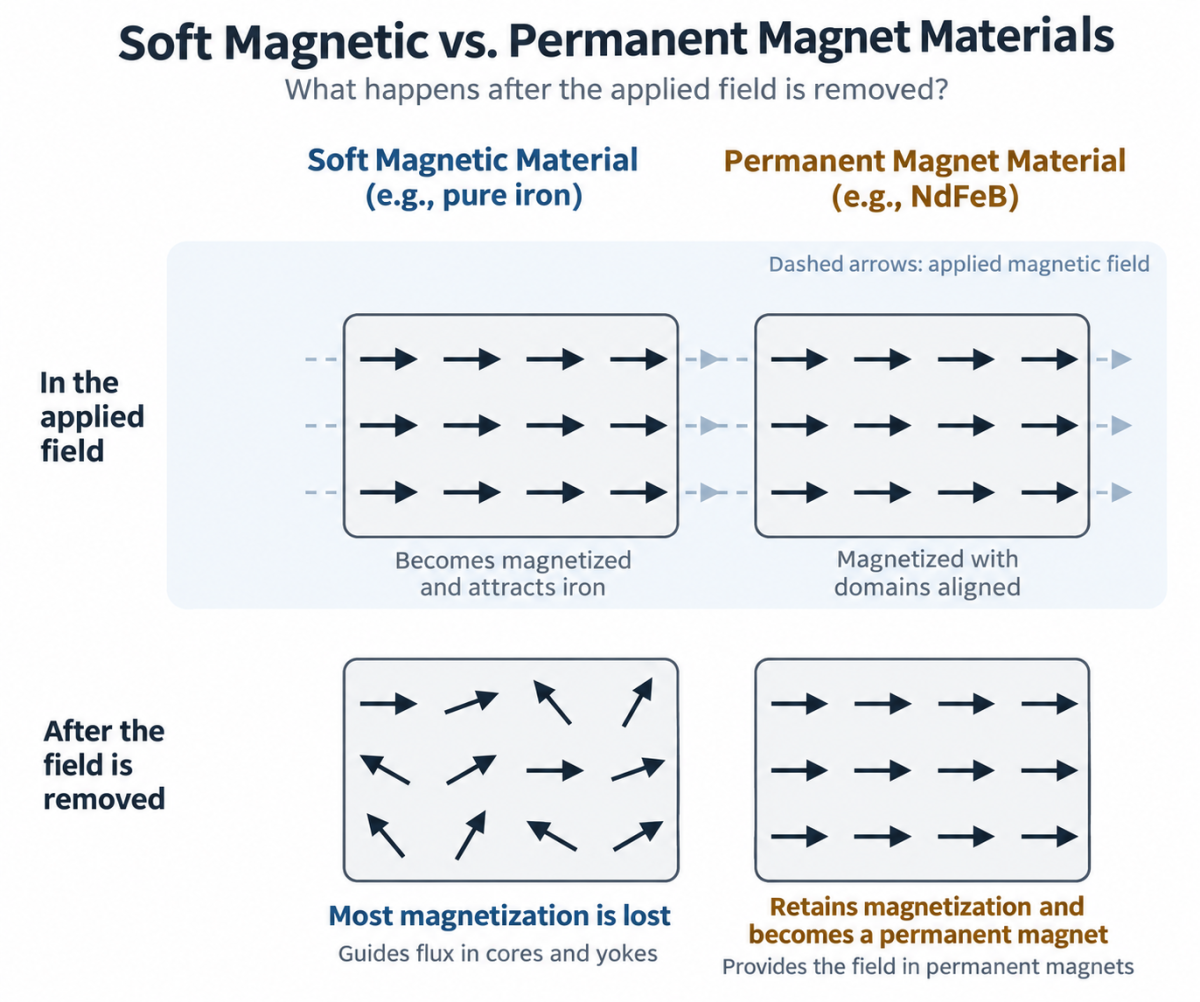
Pure iron illustrates why attraction alone tells you little about whether a material can serve as a permanent magnet. A magnet can attract pure iron strongly, yet most of the induced magnetization disappears once the external field is removed.
A permanent magnet is a physical component made from hard magnetic material. Depending on the material and manufacturing process, it may be shaped, sintered or bonded, machined, and surface-treated before it is magnetized. The Chinese industry term cígāng, literally “magnetic steel,” dates back to early permanent magnets made of steel and is still used today for permanent magnets made from a range of materials.
3. How to Evaluate a Magnet’s Performance and Stability
Several specifications describe how one permanent magnet differs from another:
- Remanence (Br) is the magnetic flux density that remains in the material after it has been magnetized to saturation and the applied field has been removed.
- Coercivity (HcB and HcJ) measures resistance to demagnetization. HcB is the reverse field needed to reduce magnetic flux density to zero. HcJ is the reverse field needed to reduce magnetic polarization to zero.
- Maximum energy product ((BH)max) is the maximum magnitude of the product of magnetic flux density and field strength on the demagnetization curve. It is a common measure for comparing permanent magnet materials.
- Curie temperature (Tc) is the temperature above which a material loses its ferromagnetic ordering.
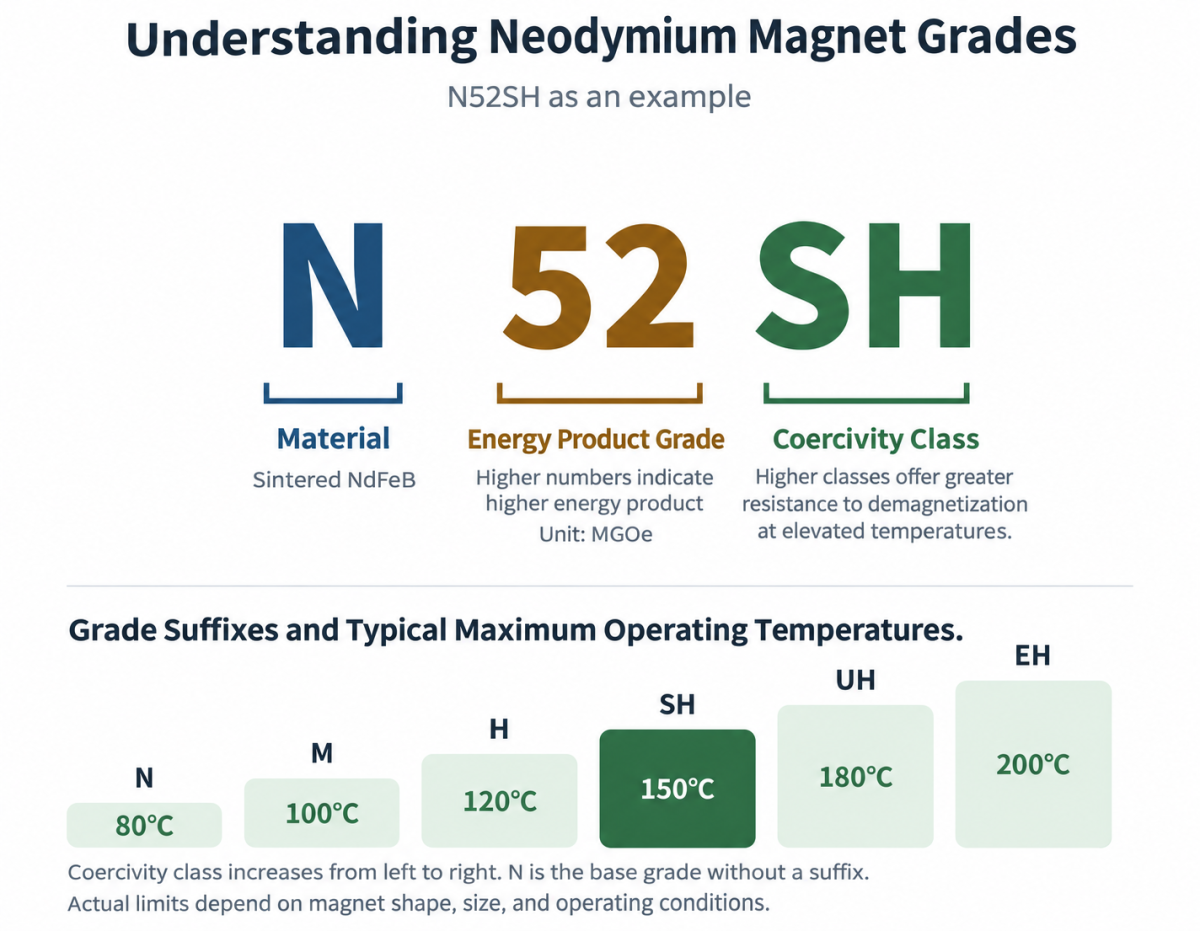
In neodymium magnet grades such as N35 and N52, the number indicates the maximum energy product grade. Suffixes such as M, H, SH, UH, and EH indicate coercivity classes related to performance at elevated temperatures. A higher number alone tells you little about how well a magnet will perform at high temperatures. The diagram below breaks down N52SH as an example.
These specifications are typically measured at room temperature. How well a magnet retains its performance depends on its operating conditions. A permanent magnet can retain its magnetization through repeated use. Excessive heat or a strong opposing magnetic field can demagnetize it, while corrosion or mechanical impact can damage it. If a magnet weakens in service, check which conditions may have exceeded its limits.
4. What’s the Difference Between a Magnetic Field and Magnetic Force?
Put a magnet on a table and it creates a field around it, even when there’s nothing nearby for it to attract.
A magnetic field is a physical field that exists in space and has both magnitude and direction. Around a magnet, it generally weakens rapidly with distance. Electric current can also produce a magnetic field. That’s how an electromagnet works. Magnetic flux density is commonly measured in tesla (T) or gauss (G). One tesla equals 10,000 gauss.
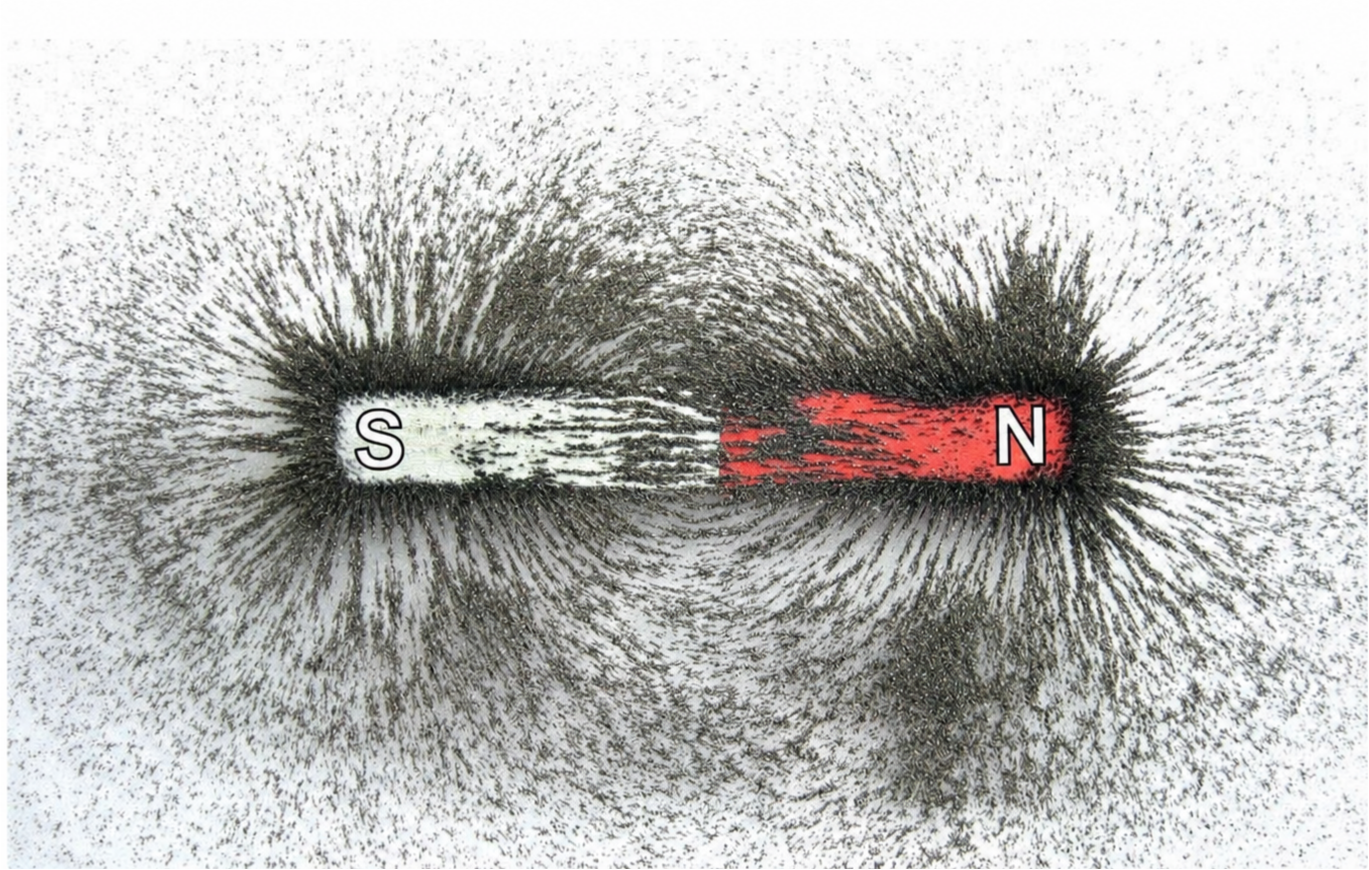
A magnetic field is invisible, but iron filings can reveal its pattern, and a gaussmeter can measure the magnetic flux density at a given point.The pattern formed by iron filings helps visualize the field. The lines we draw to represent it are a model.
Magnetic force is the push or pull that can result from a magnetic field. Bring an iron nail close to a magnet and the field temporarily magnetizes the nail, pulling it toward the magnet. Two magnets can attract or repel each other depending on how they are oriented.
A magnetic field can be present even when there is little or no measurable force on a nearby object. The magnitude and direction of the force depend on the object’s material and thickness, the field distribution, and the relative positions of the objects. The same magnet can have very different pull forces when it is placed directly against a thick steel plate or used to attract a thin steel sheet across a gap of a few millimeters.
When comparing magnet strength, specify what you’re measuring. You could be comparing the magnetic properties of the material, the field at a particular point, or the pull force under specified conditions. Surface magnetic field refers to the field measured at a point on the magnet’s surface. Remanence is a material property measured under defined conditions. Two magnets of the same grade can have very different surface fields if their shapes or dimensions differ.
5. From a Single Magnet to a Magnetic Circuit and Assembly
In engineering applications, the way a magnet is installed can matter as much as the magnet itself.
Suppose you want to increase a magnet’s pull force in one direction. A common approach is to add a low-carbon steel yoke behind or around the magnet. The yoke changes how magnetic flux is distributed and can concentrate the field at the working surface. The simulation below compares the same magnet with and without a steel yoke.
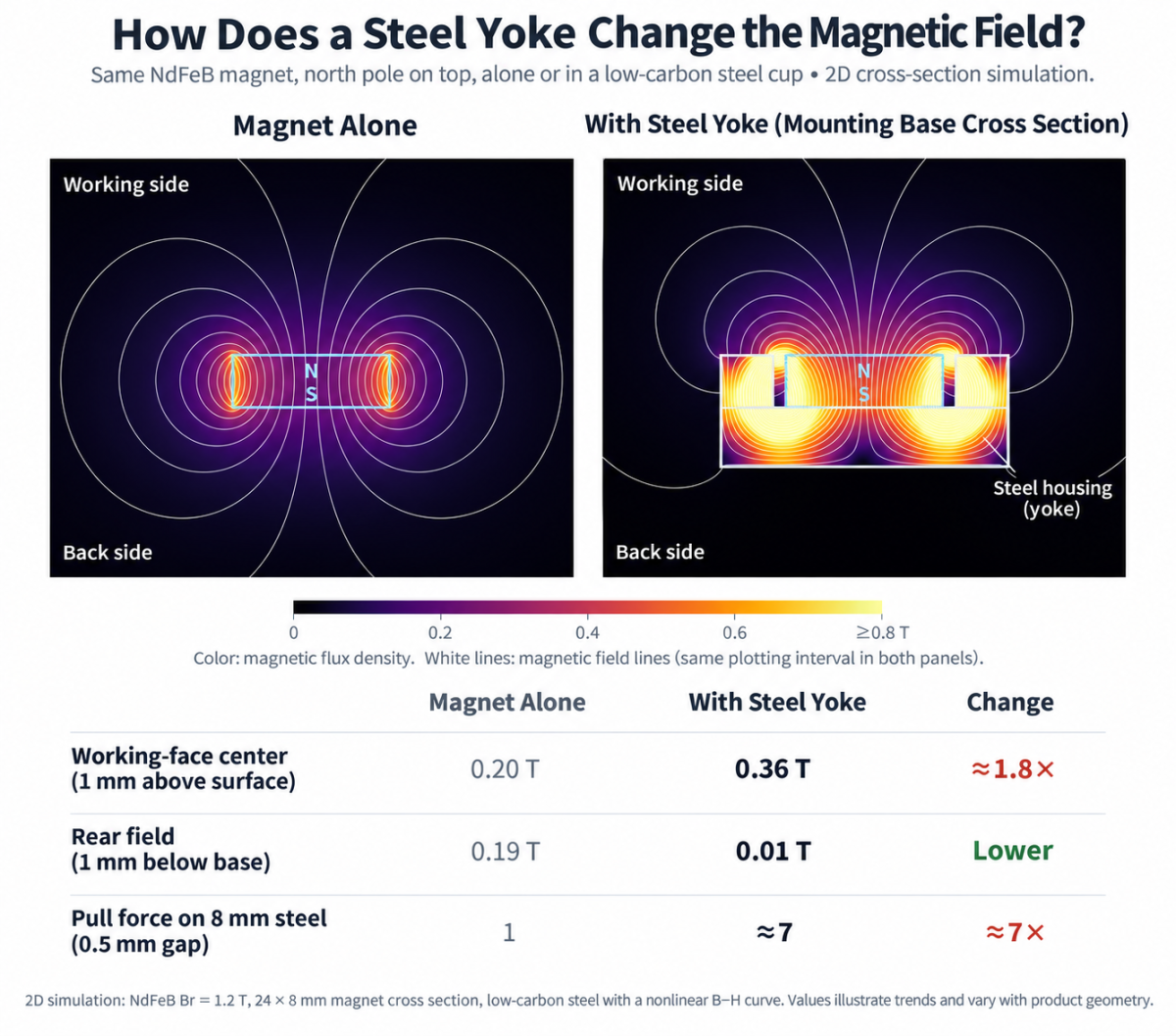
This is magnetic circuit design. Engineers arrange magnets, flux-guiding materials, and air gaps to direct magnetic flux where it is needed. The permanent magnet supplies the field, and the soft magnetic material helps guide the flux. A Halbach array offers another approach. By arranging magnets with different magnetization directions, it strengthens the field on one side of the array without requiring a soft magnetic flux guide.
Some flux inevitably spreads into the surrounding air. This is called flux leakage.
A magnetic assembly combines magnets with parts such as yokes, housings, and brackets to perform a specific function. A magnetic mounting base, for example, typically consists of a permanent magnet, a steel housing, and a mounting feature. Its pull force depends on the magnet, the complete magnetic circuit, and the mechanical design.
A magnet’s grade and surface field tell you only part of how the complete assembly will perform. Improving the magnetic circuit can deliver a greater increase in pull force at a lower cost than upgrading the magnet material.
6. Applications of Magnetism Beyond Holding Things in Place
Refrigerator magnets, magnetic hooks, and magnetic tools use attraction to hold objects in place. Magnetism also makes many other functions possible.
Electric motors use the interaction between magnetic fields and electric current to produce motion. Magnetic sensors detect changes in a field to measure position, angle, or rotational speed. Magnetic couplings transmit torque between parts without physical contact. In semiconductor coating equipment, magnets behind a magnetron sputtering target help confine electrons near the target surface. This concentrates the plasma and improves sputtering efficiency.
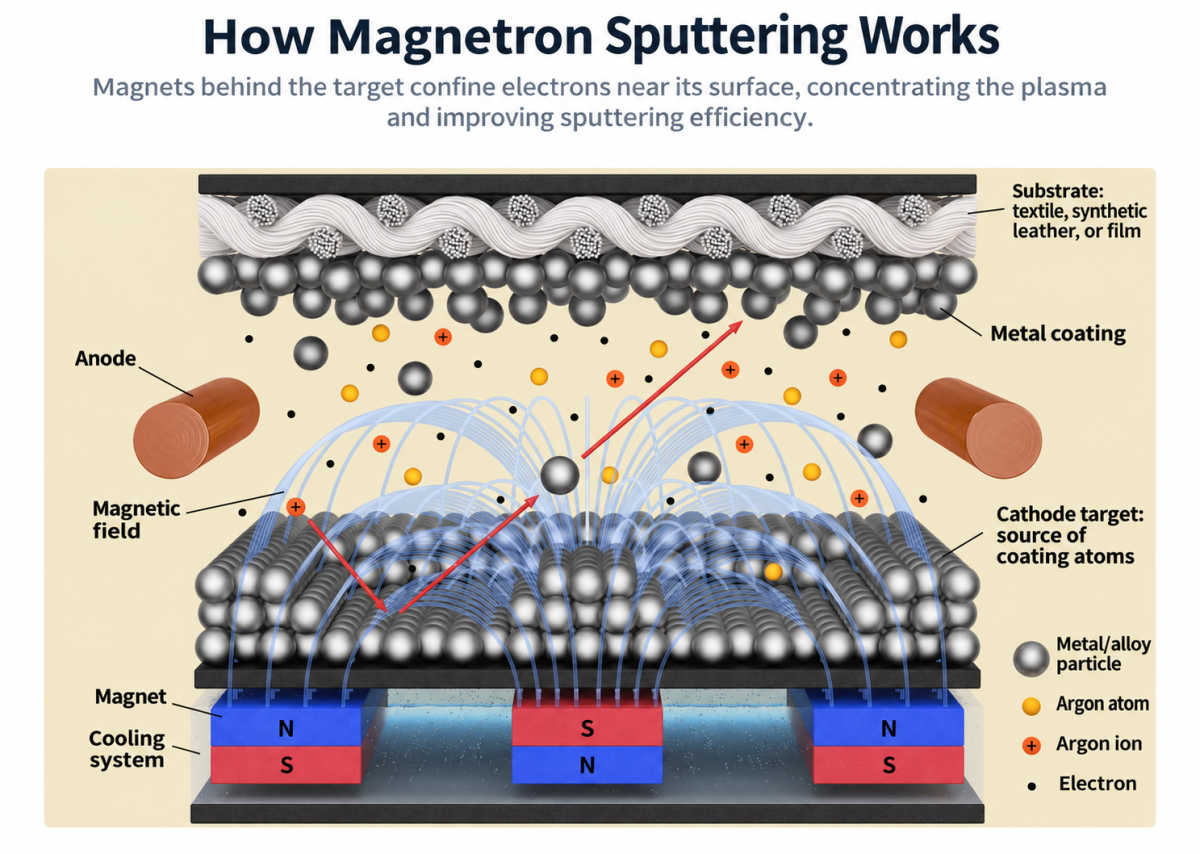
Different applications call for different magnetic properties. One application may need a stronger field, while another needs a more uniform field. Some designs require more pull force, while others need to minimize unwanted magnetic effects. A magnet that is stronger than the application requires can make assembly more difficult, raise costs, or interfere with nearby components.
What to Check When a Magnet’s Pull Force Is Too Low
If a magnet isn’t pulling hard enough, check the material and grade, the magnetic circuit, and the operating temperature. The material may be unsuitable, the circuit may be directing too little flux to the working surface, or excessive heat may have partially demagnetized the magnet. Each cause calls for a different fix.
Please give us a message
We’ll keep your personal information private
Beijing Saint Langma Magnetic Industry Technology Co., Ltd.