
Complete product specifications
Support customization
PRODUCTS
MESSAGE

A few days ago, we received an interesting inquiry from a customer:
"When I order such a large quantity of magnets, how do you make sure the delivered quantity is exactly right?"
It is a simple question, but a very practical one.
For customers purchasing thousands or even tens of thousands of magnets, accurate quantity control is just as important as product quality. After all, receiving the wrong quantity can affect production schedules, inventory planning, and assembly operations.
So, how do magnet manufacturers count and verify such large quantities?
1. Why Don't We Simply Use Automatic Counting Machines?
For many industrial components, automatic counting machines are an efficient solution. However, counting magnets is not always that simple.
Unlike ordinary metal parts, magnets attract each other. During automatic feeding and counting, two or more magnets may stick together and pass through the counting sensor as a single unit.
This can result in counting errors.
The problem becomes more challenging when magnets are small, strongly magnetized, or have irregular shapes.
Therefore, automatic counting machines are not always the most suitable option for every type of magnet.
2. How Do We Count Magnets in Actual Production?
In our daily production and packaging process, we mainly use two counting methods, depending on the order quantity and product specifications.
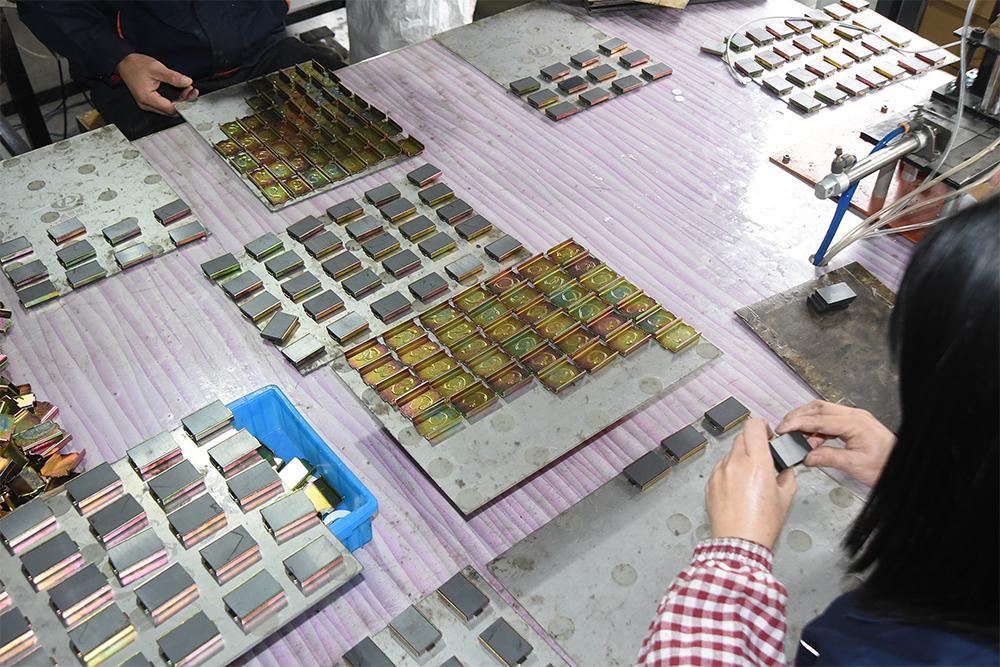
① Manual Counting – For Small-Batch Custom Orders
For small-batch orders, especially customized magnets with different shapes or specifications, manual counting is often more practical.
Workers count magnets in fixed groups, such as 10, 50, or 100 pieces, and then combine these groups to reach the required quantity.
This method is flexible and allows workers to inspect the products during counting.
② Weight-Based Counting – For Large-Volume Orders
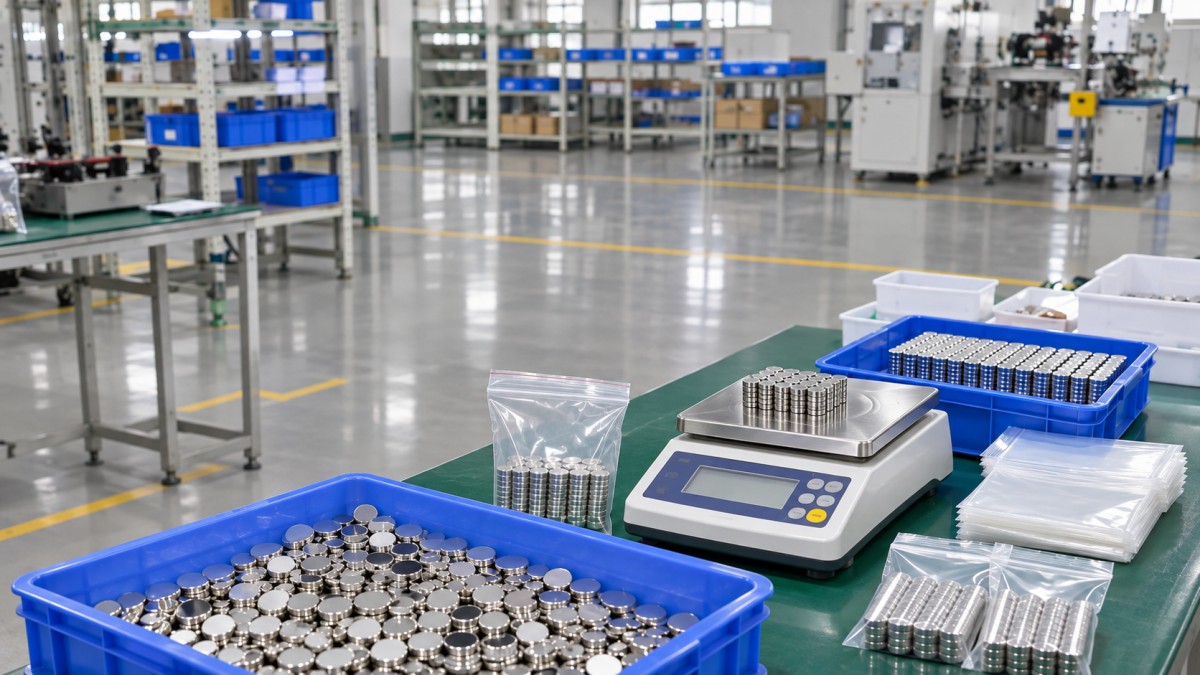
For large-volume orders, weight-based counting is generally more efficient.
The process is straightforward:
Select a sample quantity, such as 100 magnets.
Weigh the sample to calculate the average weight per magnet.
Calculate the target weight according to the required quantity.
Weigh the production batch and use the calculated weight to estimate the quantity.
For example:
If 100 magnets weigh 500 g, the average weight per magnet is 5 g.
For an order of 10,000 pieces, the theoretical total weight is 50 kg.
However, weight-based counting is not always 100% accurate. Small variations in magnet dimensions, density, and individual weight can affect the final count.
That is why weight control and sample verification are important.
3. Counting Is Only the First Step: Packaging Verification Matters Too
After counting, the magnets still need to go through a packaging and verification process.
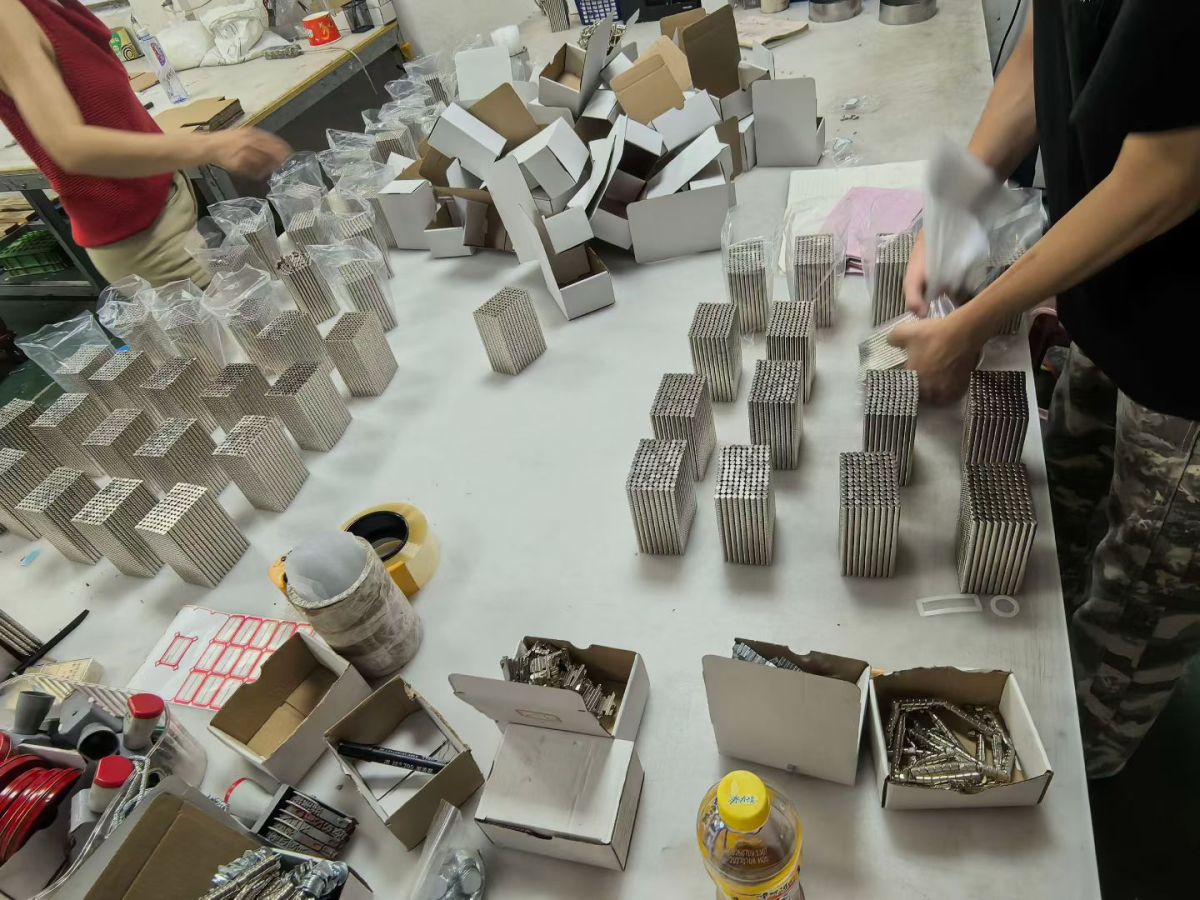
Our typical approach includes:
Quantitative Packaging: Divide magnets into fixed quantities, such as 100 pieces per bag.
Packaging Verification: Check the number of bags and cartons against the order requirements.
Final Order Check: Verify the total packaged quantity before shipment.
This additional verification helps reduce the risk of shortages or excess quantities during delivery.
4. Accurate Delivery Is Part of Product Quality
When purchasing magnets, customers naturally focus on material grade, dimensions, magnetic performance, coating, and tolerances.
But there is another detail that should not be overlooked: Are you receiving exactly what you ordered?
A reliable magnet supplier should pay attention not only to the quality of each magnet but also to the accuracy of every shipment.
Because product quality is important, but accurate delivery is part of good manufacturing too.
Please give us a message
Beijing Saint Langma Magnetic Industry Technology Co., Ltd.