
One stop solution for magnetic products
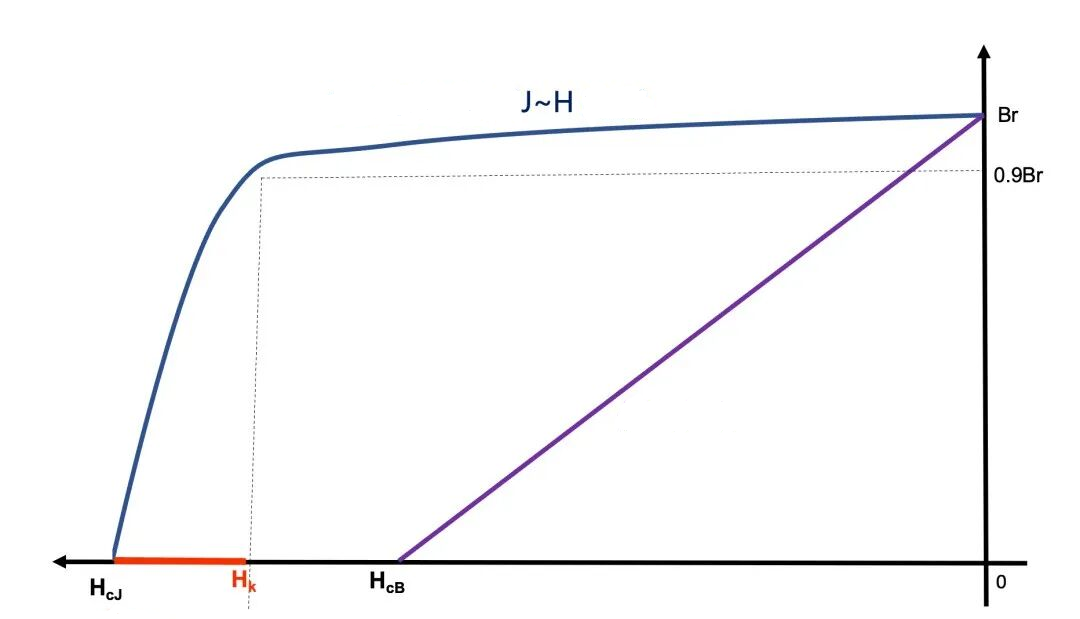
hysteresis loop and intrinsic demagnetization curve (B-H curve and J-H curve)
Permanent magnet materials exhibit two distinctive characteristics: first, they can be strongly magnetized under an external magnetic field; second, they display hysteresis, meaning they retain their magnetization even after the external field is removed. The relationship between variations in the external magnetic field and changes in the magnetic properties of a permanent magnet can be described by two curves: the hysteresis loop (B-H curve) and the intrinsic demagnetization curve (J-H curve).
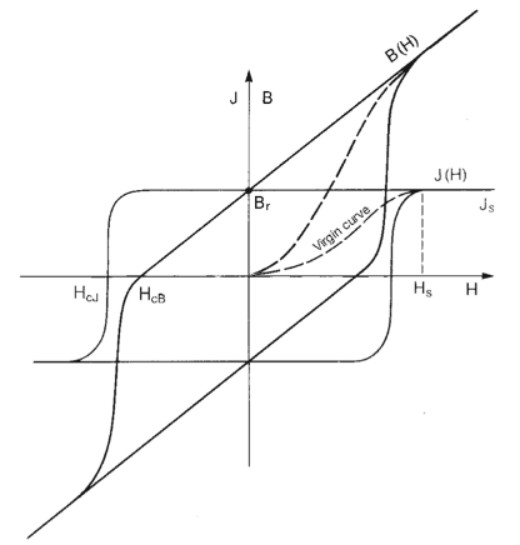
Hysteresis Loop: When the magnetic field varies sequentially in the order of Hs→Hc→O→-Hc→-Hs→-Hc→O→Hc→Hs, the corresponding magnetic flux density B traces a closed path along the curve a-Hc→d→Hc→a. This closed curve is known as the B-H curve (or hysteresis loop).
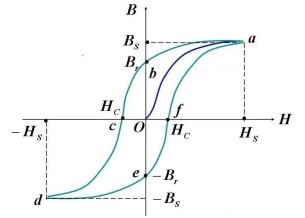
1. Initial Magnetization Curve
The origin (O ) in the figure represents the magnetically neutral state of the hard magnetic material prior to magnetization, where both B=0 and H=0 . As the magnetic field H increases from zero, the magnetic flux density B rises slowly at first, as shown by the segment oa . Subsequently, B increases rapidly with H , as depicted by segment ab . Thereafter, the growth of B slows down again. When H reaches the saturation field Hs , B attains its saturation value Bs . This red curve is referred to as the initial magnetization curve.
2. Hysteresis
When the magnetic field is gradually reduced from the saturation point Hs to zero, the magnetic flux density B does not return to the origin ("0") along the initial magnetization curve. Instead, it decreases along a new path, the curve sr . Comparing segment os with segment sr , it is evident that while B decreases as H decreases, the change in B lags behind the change in H . This phenomenon is known as hysteresis. A distinct characteristic of hysteresis is that when H=0 , B does not become zero but retains a value known as the remanent magnetization (or remanence), denoted as Br .
3. Demagnetization Curve
When the magnetic field is reversed and gradually increased from O to −Hc , the magnetic flux density B drops to zero. This indicates that to eliminate the remanent magnetization, a reverse magnetic field must be applied. The value Hc is known as the coercivity (or coercive force); its magnitude reflects the ability of the magnetic material to retain its remanent state. The purple line segment represents the demagnetization curve.
Intrinsic Demagnetization Curve: As the external magnetic field H varies, causing changes in the magnetic flux density B of the magnet, the magnetic polarization J also changes simultaneously. The relationship between these two quantities can be described by the J -H curve. This curve reflects the intrinsic magnetic properties of permanent magnet materials and is termed the intrinsic demagnetization curve (or simply the intrinsic curve). On this curve, the specific magnetic field strength at which the magnetic polarization J becomes zero is defined as the intrinsic coercivity, denoted as Hcj .
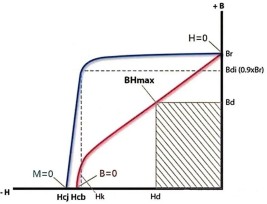
1. Knee Point (Hk )
As observed in the figure, when the reverse external magnetic field continuously increases, the magnetic polarization intensity of the magnet decreases very slowly. However, once the external field exceeds a certain threshold, the magnetic polarization intensity drops rapidly. Typically, the point on the demagnetization curve where Ji=0.9Br is referred to as the bend point or knee point of the curve. The magnetic field corresponding to this point is denoted as Hk , also known as the knee coercivity. When the external magnetic field exceeds Hk , the magnet will suffer irreversible performance loss. This is precisely why the value of Hk receives significant attention.
2. Squareness of the Demagnetization Curve (Q )
The squareness of the demagnetization curve, denoted as Q , is defined by the ratio of the knee coercivity to the intrinsic coercivity (Hk/HcJ). The value of Q ranges between 0 and 1. The closer Q is to 1, the more rectangular (or "square") the demagnetization curve becomes. Typically, products are considered qualified only if their squareness factor satisfies Q>0.9 .
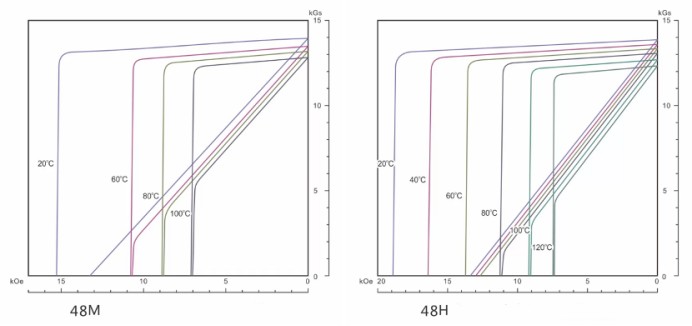
3. Demagnetization Curves at Different Temperatures
Generally, manufacturers of permanent magnet materials provide demagnetization curves for various grades at different operating temperatures, as illustrated in the figure below. Although the chart may appear complex at first glance, its essence is simply the superposition of multiple demagnetization curves and intrinsic curves onto a single graph.
Search
Categories List
Please give us a message
Beijing Saint Langma Magnetic Technology Co.,Ltd