
One stop solution for magnetic products
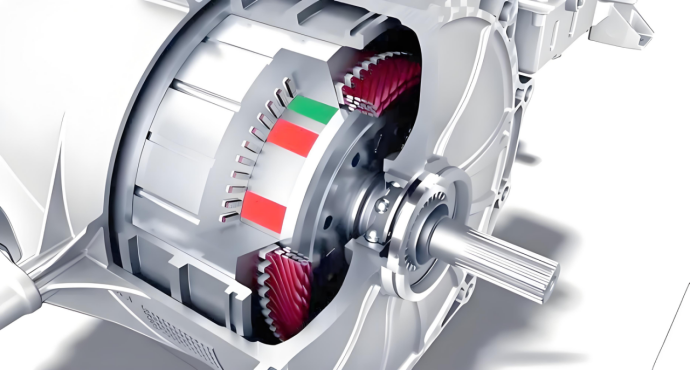
Permanent magnet motors are the main application scenario for rare earth permanent magnet materials. Motors, commonly known as "motors", are broadly divided into electric motors (converting electrical energy into mechanical energy) and generators (converting mechanical energy into electrical energy). Both operate based on the law of electromagnetic induction or electromagnetic force, with the core prerequisite of establishing an air-gap magnetic field. Accordingly, they can be categorized into electrically excited induction motors and permanent magnet motors driven by permanent magnets.
Compared with induction motors, the air-gap magnetic field of permanent magnet motors is directly generated by permanent magnets, eliminating the need for extra excitation power and additional windings. As a result, they feature high efficiency, energy saving, compact size and simple structure, and are widely used in various small and medium-sized motors.
Taking a permanent magnet DC motor model as an example, the permanent magnet creates a magnetic field at the central coil. When the coil is energized, it generates electromagnetic force and rotates. In a motor, the rotating component is the rotor and the stationary component is the stator. In this model, the permanent magnet acts as the rotor and the coil as the stator.
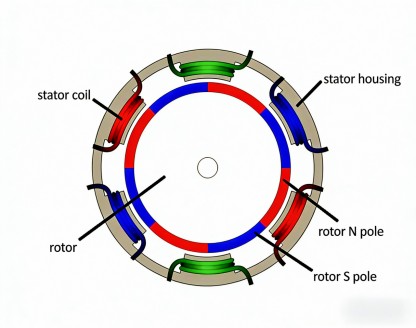
Permanent magnets are installed in different shapes and positions in different motors: in rotating electric machines, when permanent magnets serve as the stator, arc-shaped tiles with outer curvature are surface-mounted onto the casing; when used as rotors, arc-shaped tiles with inner curvature or rectangular sheet magnets are embedded into the rotor core, as shown in the following figure.

Permanent magnets for linear motors are mainly square or parallelogram-shaped. Axial magnetized ring magnets are required for cylindrical linear motors.
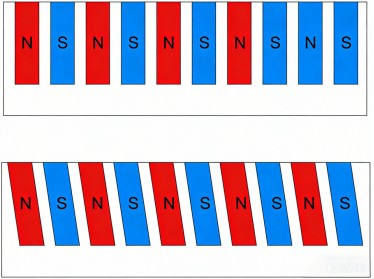
To meet the operating requirements of motors, magnetic steels for permanent magnet motors have the following characteristics:
1. Simple shape: Except for special micro motors such as VCMs, most are simple shapes such as rectangles and arcs. Driven by cost reduction demands, embedded rectangular magnetic steels are increasingly applied.
2. Simple magnetization process: Mostly single-pole magnetization is adopted, forming a multi-pole magnetic circuit after assembly; integral ring magnets (such as bonded NdFeB and hot-pressed magnetic rings) usually use multi-pole radial magnetization.
3. Core technical requirements: High-temperature stability, magnetic flux consistency and adaptability. Surface-mounted rotor magnetic steels require good adhesive bonding; linear motors and wind power generation magnetic steels have increasingly stringent salt-spray resistance requirements; drive motor magnetic steels demand excellent high-temperature stability.
4. Wide range of magnetic energy products: Covering high, medium and low grades, with most coercivity at medium to high levels. Magnetic steels for electric vehicle drive motors mostly select grades with high magnetic energy product and high coercivity (such as 45UH, 48UH, N48EH, etc.), and mature grain boundary diffusion technology is key to performance.
5. Segmented bonded magnetic steels are widely used in high-temperature motors to improve insulation and reduce eddy current loss; some magnetic steels are coated with epoxy on the surface to enhance insulation.
To ensure magnetic steels meet motor requirements, strict testing is required, with three core items:
· High-temperature stability: Customers have different requirements for magnetic loss testing (open-circuit or semi-open-circuit). During motor operation, magnetic steels are subjected to high temperatures and alternating reverse magnetic fields, so the magnetic loss of finished products and the high-temperature demagnetization curves of base materials must be strictly tested and monitored.
· Magnetic flux consistency: Flux deviation causes motor vibration and power reduction. The general tolerance is ≤5%, and some require ≤3% or 2%. Influencing factors including remanence, dimensional tolerance, chamfering and coating must be considered.
· Adaptability: Conventional testing of the included angle and radian of arc-shaped surface-mounted magnetic steels has large errors, so adaptability must be verified (controlling cumulative gaps and assembly fit). The optimal method is to use custom profiling fixtures for inspection according to the user’s assembly method.
Search
Categories List
Please give us a message
Beijing Saint Langma Magnetic Technology Co.,Ltd