
One stop solution for magnetic products
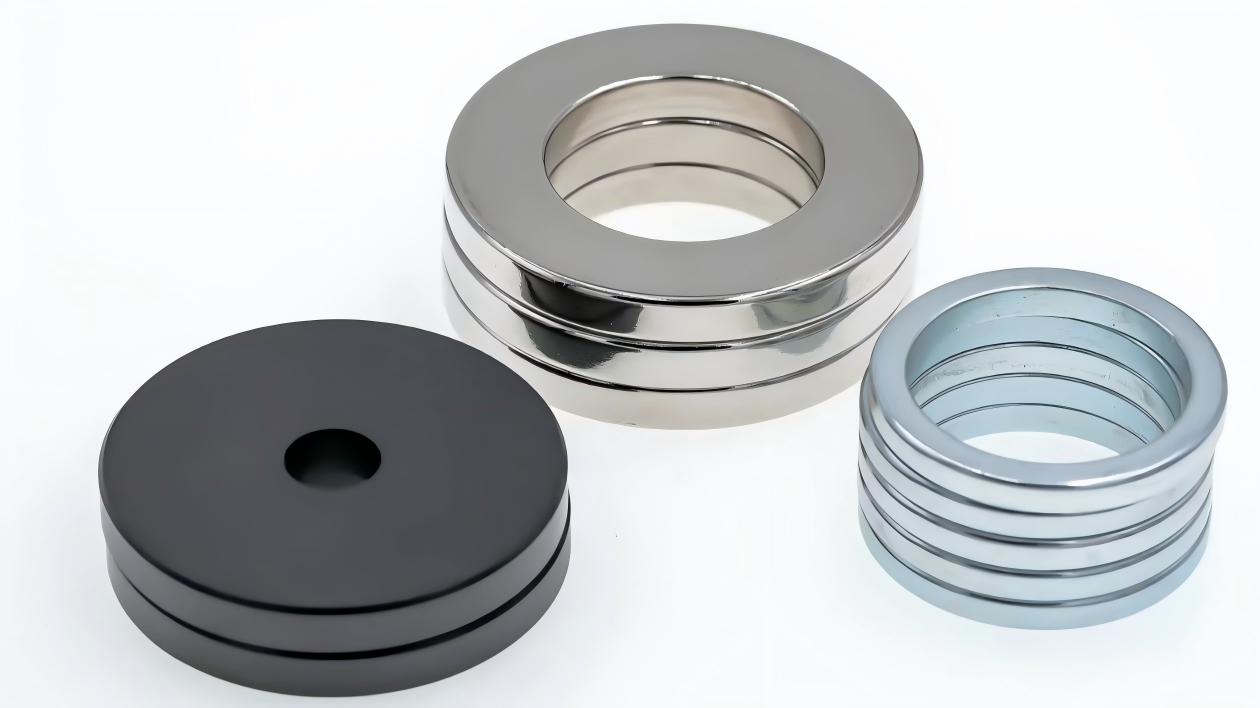
When it comes to permanent magnet materials, it is easy to assume that stronger magnets always lead to better industrial applications.
Over the past century, however, the development of permanent magnets tells a more complicated story.
Ferrite magnets helped make electric motors more affordable. Samarium cobalt magnets enabled smaller and more temperature-resistant devices. Later, neodymium magnets pushed power density to a new level, supporting applications ranging from hard disk drives and power tools to electric vehicles and industrial robots.
The history of permanent magnet materials is therefore not simply a race toward higher magnetic strength.
It is a continuous search for the right magnetic material for a specific engineering requirement.
Cost, size, temperature resistance, corrosion resistance, demagnetization resistance, mechanical properties, manufacturing requirements and supply stability can all determine which magnet is actually the best choice.
1. Ferrite Magnets: Solving the Cost Problem
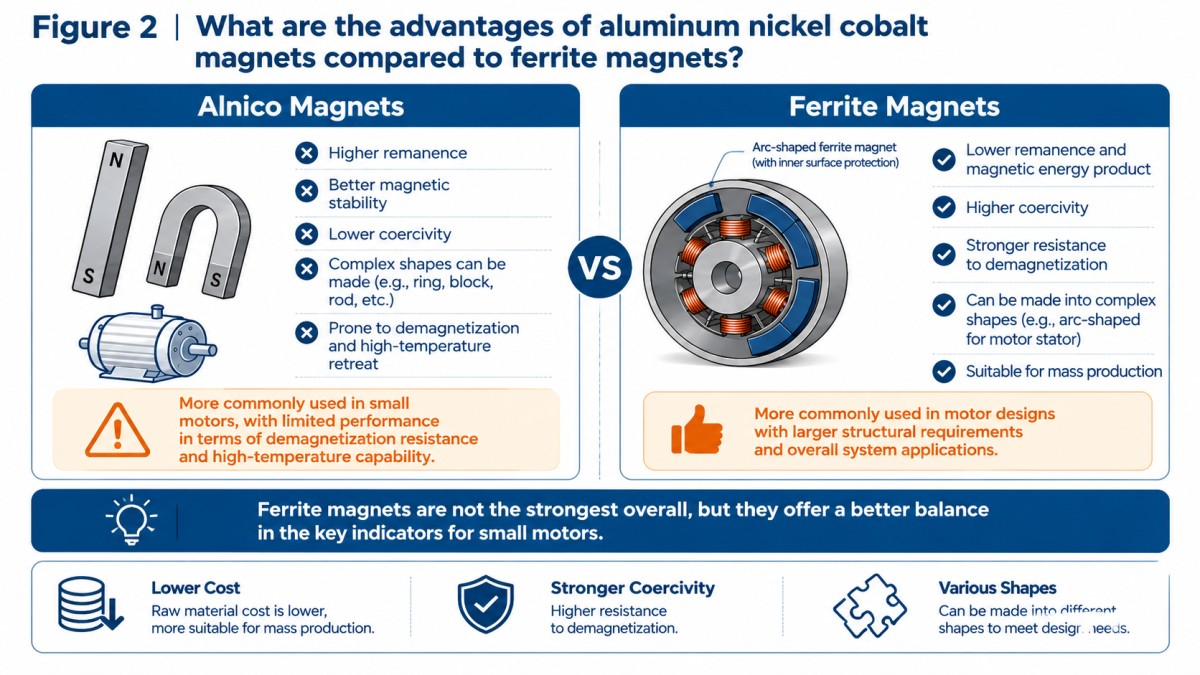
Before ferrite magnets became widely available, Alnico magnets were among the most important industrial permanent magnets.
Alnico offered relatively high remanence and excellent temperature stability, making it useful in motors, speakers, meters and other equipment. However, its use of alloying elements such as nickel and cobalt made it relatively expensive for cost-sensitive applications.
The commercialization of ferrite magnets in the 1950s changed this situation.
Ferrite did not outperform Alnico in every magnetic parameter. Its magnetic energy product was relatively modest, and larger magnets were often required to achieve the same magnetic performance.
Its advantage was elsewhere.
Ferrite magnets offered high coercivity, good resistance to demagnetization, low material cost and good corrosion resistance. They were also suitable for mass production.
These characteristics made ferrite particularly attractive for small DC motors.
As automotive systems became increasingly electrified, ferrite magnets found applications in: Windshield wiper motors、Blower motors、Power window systems、Seat adjustment motors、Door lock systems、HVAC actuators.
Each individual motor did not necessarily require extremely high magnetic performance. Instead, manufacturers needed a magnet that could provide stable performance at a low cost.
This is an important lesson in magnet selection:
The strongest magnet is not always the most suitable magnet.
Ferrite became successful because it solved the cost and manufacturing constraints of mass-market applications.
2. SmCo Magnets: High Performance in Compact and High-Temperature Applications
As consumer electronics became smaller during the 1970s and 1980s, a new engineering challenge appeared.
Devices such as cassette players, CD players and other compact electronic equipment needed smaller motors, actuators and speakers.
Ferrite magnets were inexpensive, but their relatively low magnetic performance meant that more magnet volume was often required. This created opportunities for samarium cobalt magnets (SmCo magnets).
Compared with ferrite, SmCo magnets can provide significantly higher magnetic performance in a smaller volume. They also offer excellent temperature stability and strong resistance to demagnetization.
These properties made SmCo magnets suitable for applications where both compact size and reliable operation at elevated temperatures were important.
Typical applications include: Precision motors、Sensors、Aerospace equipment、High-temperature actuators、Compact electronic devices、High-reliability motor systems.
However, SmCo did not simply replace ferrite.
Ferrite remained attractive for cost-sensitive applications, while SmCo occupied applications where high performance, compact size and temperature resistance justified the higher material cost.
Again, material selection was determined by the application rather than by magnetic strength alone.
3. NdFeB Magnets: Taking Power Density to a New Level
The development of neodymium magnets, also known as NdFeB magnets or neodymium iron boron magnets, marked another major change in permanent magnet technology.
Commercialized in the 1980s, NdFeB magnets offered an extremely high magnetic energy product compared with many earlier permanent magnet materials.
This made it possible to generate strong magnetic fields from much smaller magnet volumes.
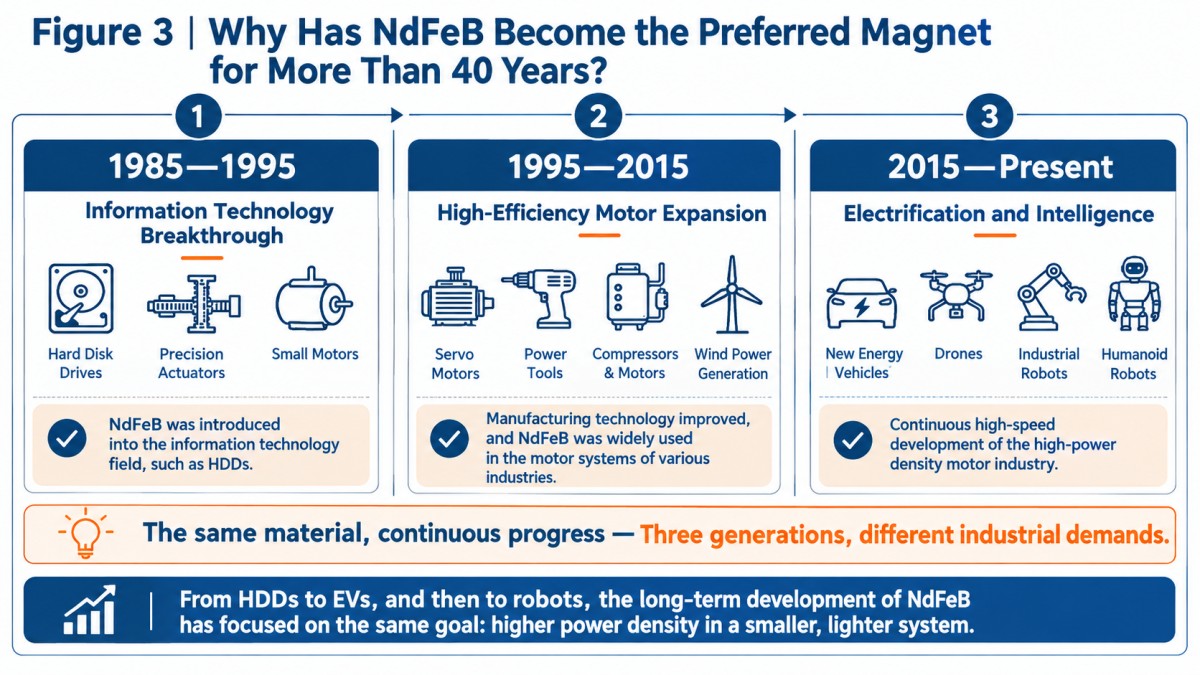
One of the early important application areas was data storage.
During the rapid development of personal computers and hard disk drives, manufacturers needed increasingly compact and precise actuator systems. NdFeB magnets provided new design possibilities for voice coil motors and other miniature electromagnetic devices.
As manufacturing technology matured and costs became more competitive, NdFeB magnets expanded into a much wider range of industries.
Today, NdFeB magnets are widely associated with applications such as: Servo motors, Industrial automation, Electric tools, Medical equipment, Compressors, Automotive systems, Electric vehicles, Drones, Industrial robots, Collaborative robots, Robotic actuators.
Although these products belong to very different industries, many of them share the same fundamental engineering objective:
More torque and power from a smaller and lighter system.
This is where the importance of magnetic energy product becomes clear.
Higher magnetic performance is valuable not simply because the magnet itself is stronger, but because it can enable: Smaller motors, Lighter actuators, Higher torque density, Higher power density, More compact product designs.
From hard disk drives to electric vehicles and robot joints, the underlying engineering trend is similar: electrical machines continue to pursue higher power density, and NdFeB magnets have played an important role in enabling that development.
4. Why Haven't New Permanent Magnet Materials Replaced the Old Ones?
If NdFeB magnets offer such high magnetic performance, why are ferrite magnets and SmCo magnets still widely used?
Because real-world engineering involves much more than magnetic strength.
Before selecting a permanent magnet material, engineers may need to evaluate:
This explains why different permanent magnet materials continue to coexist.
5.Choosing the Right Permanent Magnet Material
There is no universal “best” permanent magnet. The right choice depends on the requirements of the application.
A simplified selection guide looks like this:
Actual material selection should also consider the magnet's grade, operating temperature, magnetic circuit, dimensions, coating, mechanical requirements and working environment.
For this reason, custom magnets are often more appropriate than simply selecting a magnet based on its nominal magnetic strength.
6. The Future of Permanent Magnets Is Not Simply “Stronger”
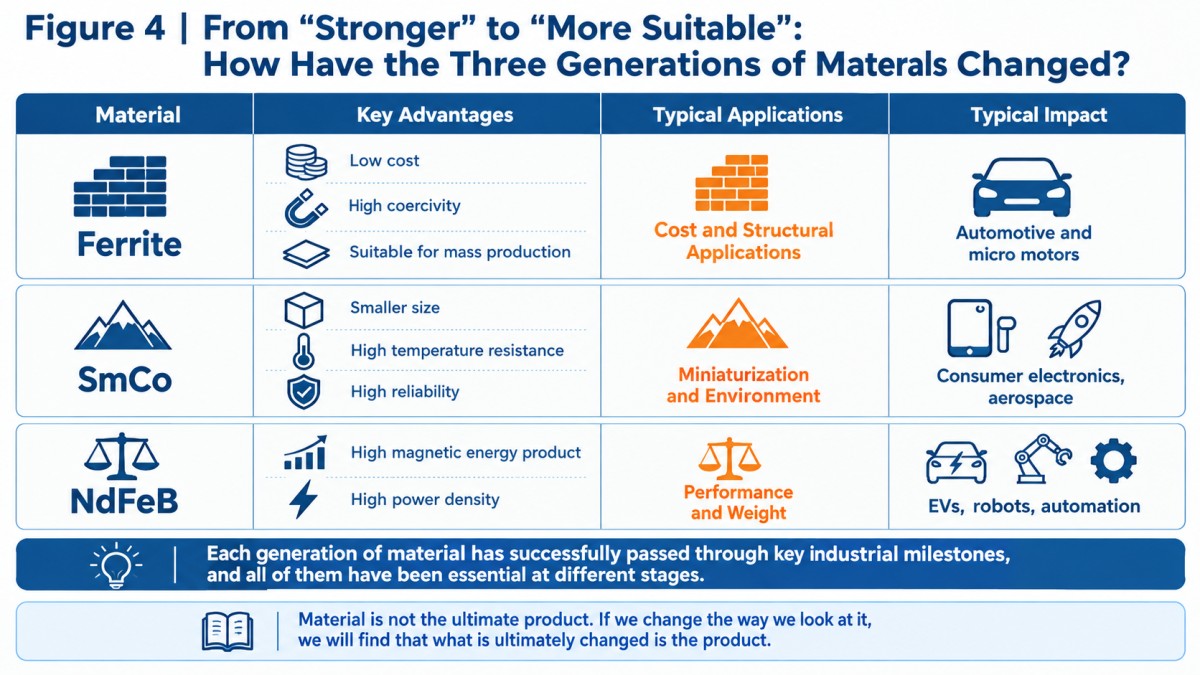
Looking back at the development of Alnico, ferrite, SmCo and NdFeB, each major material brought something different to the industry.
Ferrite addressed cost and mass production.
SmCo addressed compact size, temperature resistance and reliability.
NdFeB addressed high magnetic performance and power density.
The success of these materials was not determined by whether they were universally stronger than their predecessors.
Instead, they succeeded because they solved the most important engineering constraint of their time. That is why the future of permanent magnet technology may not be defined by a single question such as:
“How strong can a magnet become?”
The more important question is: “How can we provide the right magnetic performance with the right cost, size, temperature resistance, durability and resource requirements?”
From automotive motors to electric vehicles, industrial automation and robotics, the industrial value of a magnet has never been determined by magnetic strength alone.
The real breakthrough is not always a stronger magnet. It is a more suitable magnet.
Search
Categories List
Please give us a message
Beijing Saint Langma Magnetic Technology Co.,Ltd