
One stop solution for magnetic products
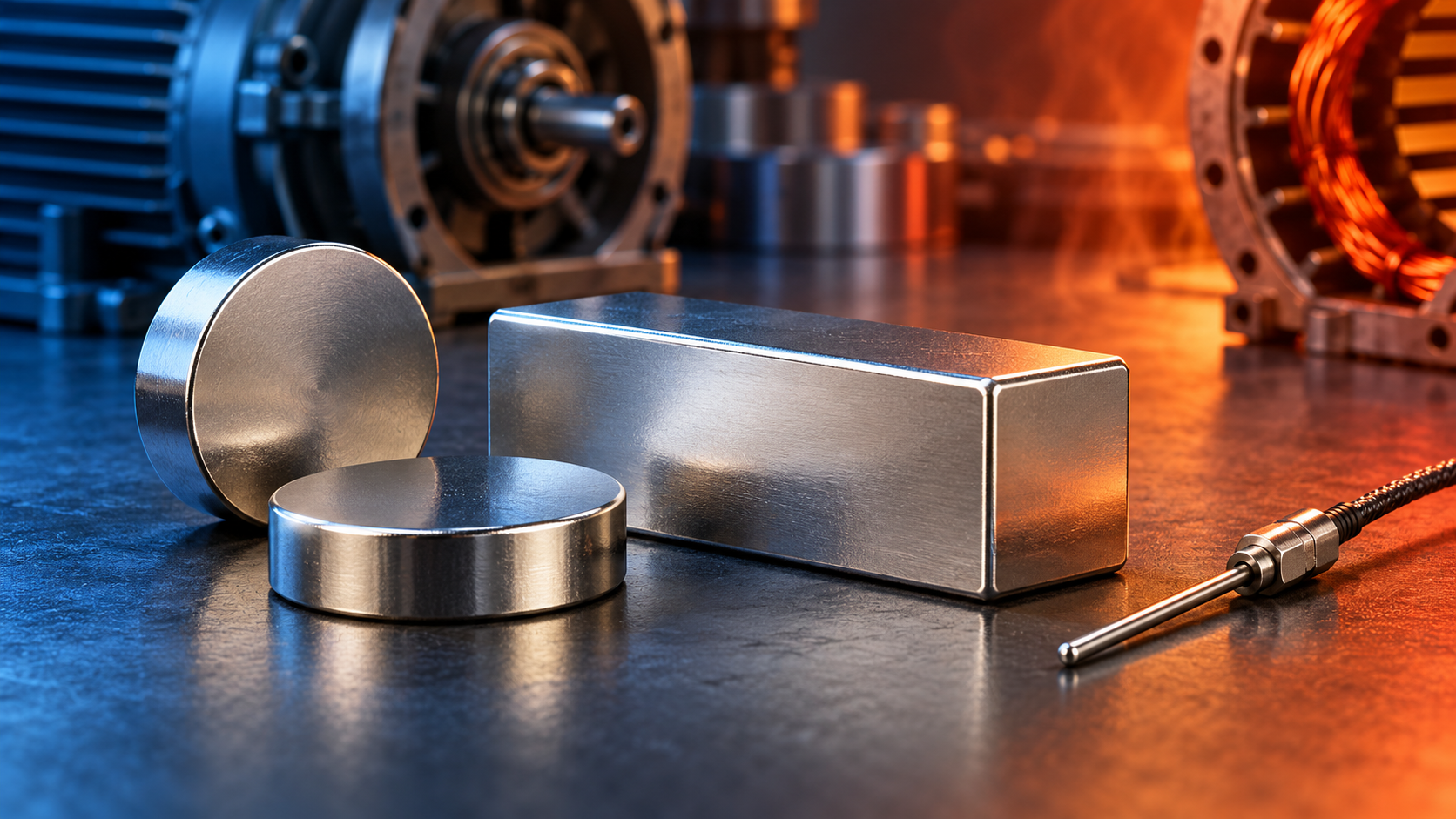
“This magnet is rated for operation at 120°C. Why has its magnetic strength decreased before the equipment even reaches that temperature?”
This is a common source of confusion for buyers and engineers selecting and using magnets. If a grade rated for 120°C has been selected, why can demagnetization still occur?
The key is that the maximum operating temperature listed in a magnet grade table applies under specific conditions. Whether a magnet can operate reliably in an actual assembly also depends on its dimensions, magnetization direction, magnetic circuit, and external opposing magnetic fields.
This article focuses on sintered neodymium magnets, explaining the relationship between temperature and demagnetization and the conditions that should be confirmed during purchasing and design.
1. Reduced Magnetic Strength Does Not Necessarily Mean Irreversible Demagnetization
Suppose an H-grade neodymium magnet with a nominal maximum operating temperature of approximately 120°C shows reduced holding force when the equipment reaches 100°C. This observation alone does not establish that the magnet has permanently demagnetized.
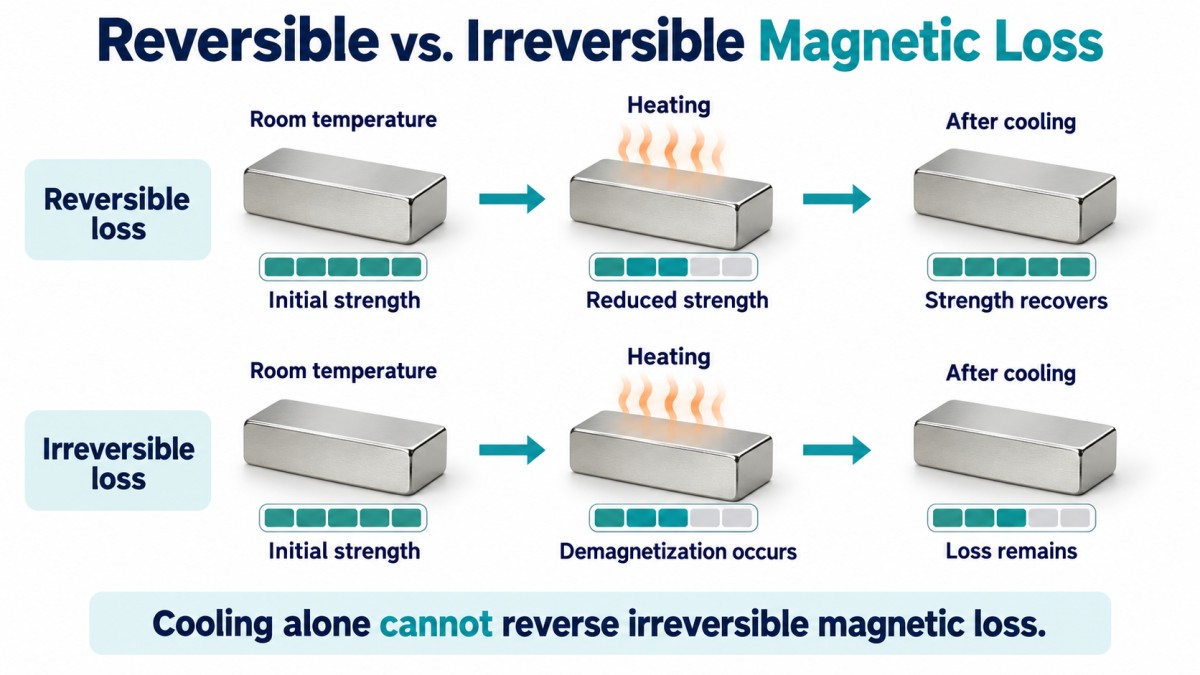
First, it is necessary to distinguish between two types of magnetic performance loss.
Reversible Magnetic Loss: Performance Largely Recovers After Cooling
The magnetic properties of neodymium magnets change with temperature. Within a certain temperature and operating range, remanence decreases as temperature rises, weakening the magnetic field produced by the magnet.
If no irreversible changes occur, the magnetic properties generally recover substantially once the magnet returns to its original temperature.
A magnet becoming weaker at an elevated temperature does not necessarily mean it will remain weaker after cooling.
Irreversible Magnetic Loss: Cooling Alone Cannot Restore Performance
If elevated temperatures or sufficiently strong demagnetizing fields cause irreversible changes in the magnetization of some regions, the magnet will not return to its original magnetic performance after cooling. This is known as irreversible magnetic loss.
Here, “irreversible” means that cooling alone cannot restore the lost performance. If the magnet has not suffered significant material damage or structural changes, some magnetic losses may still be recovered through remagnetization.
2. What Does a 120°C Temperature Rating Actually Mean?
Neodymium magnet grades typically consist of a number and a suffix, such as N42H or N38SH.
The number generally corresponds to the maximum energy product grade, while suffixes such as H and SH indicate intrinsic coercivity classes. Common reference maximum operating temperatures are shown below.
These values are intended for preliminary selection. They are not guaranteed limits for every magnet geometry and installation condition. Material properties, test conditions, and recommended operating ranges may also vary between suppliers.
The maximum operating temperature and the Curie temperature are also different concepts. In practical applications, irreversible demagnetization can occur far below the Curie temperature. The Curie temperature should therefore not be used as a safe operating temperature for equipment.
3. The Effect of Temperature on Magnets: Reduced Strength and Lower Resistance to Demagnetization
Two parameters are particularly relevant to thermal demagnetization: remanence, Br, and intrinsic coercivity, Hcj.
They can be understood as follows:
Remanence, Br: The level of magnetic flux density retained by the material under specified conditions.
Intrinsic coercivity, Hcj: The material’s ability to resist demagnetization by an opposing magnetic field.
For neodymium magnets, both parameters generally decrease as temperature rises.
Lower remanence makes a magnet weaker at elevated temperatures. Lower magnetic coercivity makes it less resistant to demagnetizing effects.
As a result, magnetic field conditions that a magnet can withstand at room temperature may no longer be safe at elevated temperatures.
This also explains why selection should not be based solely on numbers such as N42, N48, or N52. A higher maximum energy product grade does not automatically provide better resistance to demagnetization at high temperatures.
4. Why Can Demagnetization Occur Below 120°C?
Understanding how to demagnetize a magnet also helps explain why demagnetization can occur unintentionally: temperature affects the material’s resistance to demagnetization, while magnet geometry, the magnetic circuit, and external magnetic fields together determine the demagnetizing effects it experiences.
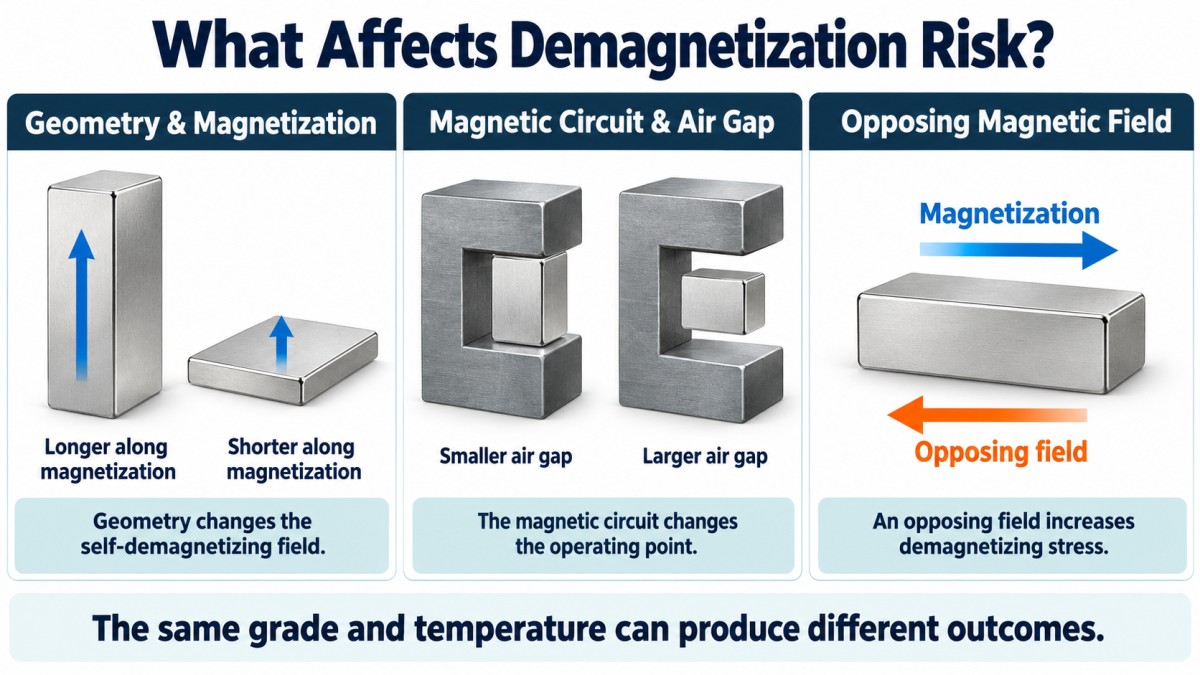
Magnet Geometry and Magnetization Direction Affect Demagnetization Risk
A magnet produces its own demagnetizing field, whose influence depends on the magnet’s geometry and magnetization direction.
For example, a thin magnet magnetized through its thickness and a relatively long cylinder magnetized along its axis can operate under substantially different conditions, even when both use the same material grade.
With other conditions being similar, magnets with a shorter dimension along the magnetization direction generally face less favorable self-demagnetizing conditions.
The Magnetic Circuit and Air Gap Change the Operating Point
The structure in which a magnet is installed also affects its demagnetization risk.
For example, a magnet operating in a relatively complete magnetic return path experiences different conditions from the same magnet removed from the assembly and placed on its own. Increasing the air gap, removing ferromagnetic components, or changing the assembly structure can all reduce the available margin against demagnetization.
This means that a magnet that operates reliably in one assembly may not remain suitable in another.
External Opposing Magnetic Fields Increase the Demagnetizing Effect
In applications such as motors and loudspeakers, magnets can be exposed to opposing magnetic fields during operation. If their coercivity is insufficient, demagnetization may occur even without exceeding the nominal temperature rating.
Demagnetization is not necessarily a gradual process. A single brief but unfavorable temperature or magnetic field event can cause a significant loss.
5. Connecting Temperature, Geometry, and Magnetic Fields Through Demagnetization Curves
These factors can be understood together by examining a magnet’s demagnetization curves and operating point.
Demagnetization curves describe a material’s magnetic properties under different magnetic field conditions. Magnet geometry and the magnetic circuit influence the operating point, temperature changes the curves, and an external opposing magnetic field can push the operating point further toward unfavorable conditions.
When local operating conditions enter the knee region of the demagnetization curve at the relevant temperature, irreversible magnetic loss may occur.
For example, an H-grade magnet may have a reference maximum operating temperature of 120°C. However, if it is thin along the magnetization direction, operates with a large air gap, and experiences a strong opposing magnetic field, it may already have insufficient resistance to demagnetization at 100°C.
The deciding factor is whether the actual operating point remains in a safe region at that temperature.
For motors or complex magnetic assemblies, high-temperature demagnetization curves supplied by the manufacturer should be combined with magnetic field simulation and prototype testing when necessary. Particular attention should be paid to local demagnetization risks.
6. Assembly Processes Can Also Cause Premature Demagnetization
Some magnets experience magnetic losses during assembly, before the equipment begins operating.
Processes that require attention include:
Heat curing of adhesives.
Baking of coatings or assemblies.
Welding near the magnet.
Other manufacturing or assembly operations that can create localized high temperatures.

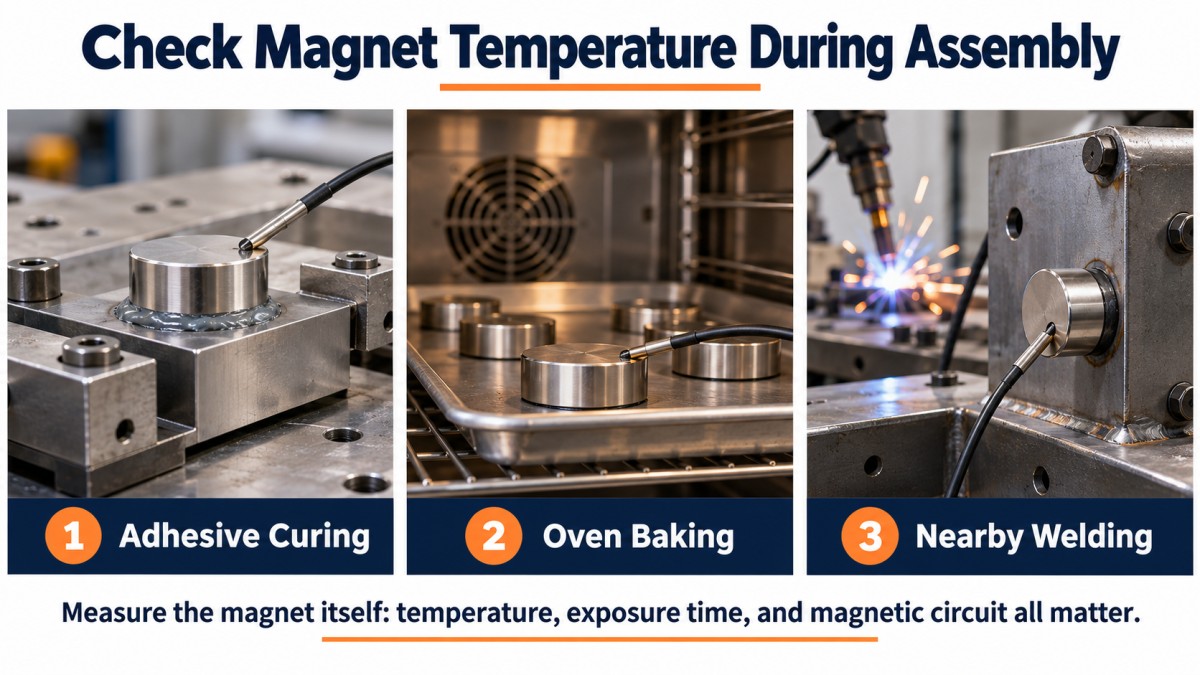
The relevant factor is the actual temperature experienced by the magnet itself. The oven setpoint, equipment display, or temperature measured nearby may not represent the magnet’s highest temperature.
For heating processes performed after magnetization, the temperature, exposure duration, and magnetic circuit conditions during heating should be reviewed in advance. Where practical, completing high-temperature processes before magnetization can be considered, provided that magnetizing the finished assembly is feasible.
7. How to Prevent Magnet Demagnetization: Information to Provide During Purchasing and Design
For more reliable selection of high temperature neodymium magnets, the following conditions should be confirmed before requesting a quotation or ordering samples.
Selection should consider the most unfavorable combination of temperature and magnetic field that may actually occur, rather than assessing average temperatures and normal operating conditions separately.
8. Frequently Asked Questions
Can a Magnet Rated for 120°C Operate Continuously at 120°C?
The nominal rating alone is insufficient to determine this. Magnet dimensions, magnetization direction, the magnetic circuit, external opposing magnetic fields, and allowable magnetic loss must all be considered. Suitability should be confirmed using performance data and testing at the relevant temperature.
Will a Magnet Always Recover Its Strength After Cooling?
If the change is caused only by reversible temperature effects, magnetic performance generally recovers substantially after cooling. If irreversible magnetic loss has occurred, cooling alone cannot restore it. Remagnetization may be necessary in some cases.
Are Higher-Numbered Neodymium Magnet Grades More Resistant to Demagnetization?
Not necessarily. The grade number primarily corresponds to the maximum energy product. Resistance to demagnetization also depends on Hcj and how it changes with temperature. Grade numbers alone are insufficient for comparison.
If a Magnet Loses Holding Force After Two Years, Is Heat Necessarily the Cause?
No. Other possible causes include corrosion, chipping or cracking, changes in the air gap or the attracted component, loose assemblies, and differences in measurement conditions. Reduced holding force is an observed result; its cause must be assessed using the actual operating conditions.
Select Magnets for Actual Operating Conditions
A nominal 120°C rating helps buyers and engineers make an initial material selection. However, the practical neodymium magnet temperature limit still depends on how hot the magnet actually becomes, the demagnetizing effects it experiences, and whether sufficient margin remains under the most unfavorable operating conditions.
Search
Categories List
Please give us a message
Beijing Saint Langma Magnetic Technology Co.,Ltd