
One stop solution for magnetic products
In traditional permanent magnet brushless motors, the method of assembling magnetic tiles into a ring has many drawbacks, such as stringent precision requirements, complex assembly, and discontinuous magnetic circuits leading to high operating noise and vibration. In contrast, integrally formed radially oriented magnetic rings, due to their continuous and uniform magnetic field, can significantly improve motor stability and efficiency, making them the optimal choice for high-end applications such as servo systems and magnetic drives.
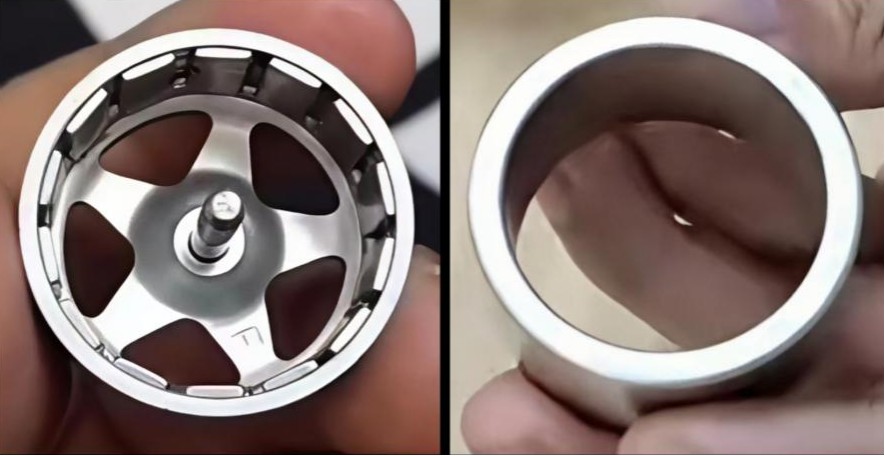
Traditional Segmented Magnetic Ring One-Piece Magnetic Ring
Pain Points of Traditional Spliced Magnetic Rings (Surface-Mounted/Embedded)
High Precision Dependence。
Each magnet segment requires extremely tight tolerances in dimensions, arc geometry, and magnetic consistency, leading to high manufacturing costs.
Complex Assembly
Segments must be bonded or installed individually and fixed with additional non-magnetic or soft-magnetic structures (such as magnetic yokes or stainless-steel sleeves), resulting in complicated processes and low efficiency.
Discontinuous Magnetic Circuits
Physical gaps between segments cause magnetic flux distortion in transition areas, resulting in cogging torque and torque ripple.
Noise and Vibration
Magnetic discontinuity and assembly errors are major in sources of electromagnetic noise and vibration, especially noticeable in high-precision servo motors.
Structural Limitations
Frame-based fixation increases radial space occupation and overall weight.
Radially Oriented Magnet Rings offer the ideal technical solution to these challenges. Their core advantage lies in achieving a continuous, uniform radial magnetic field orientation across the entire circumference of the ring magnet.
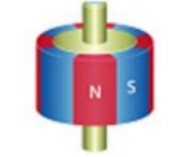
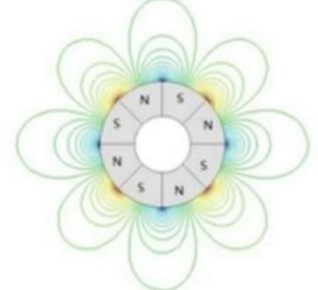
Key Advantages of Radially Oriented Magnet Rings (Bonded/Sintered Radial Anisotropic Magnet Rings)
Continuous & Uniform Magnetic Circuits
As a one-piece component, the magnet ring delivers a seamless, circumferentially continuous magnetic field distribution, which significantly reduces torque ripple and cogging torque.
High Operational Stability
Smooth magnetic pole transition ensures quieter and more stable motor operation, making it ideal for high-precision servo systems and low-noise applications.
Simplified Structure & Assembly
As a single integrated component, no segment splicing and complex fixing frames. The ring can be directly mounted onto the rotor core, greatly improving assembly efficiency and consistency.
Flexible Design Capability
Through optimized magnetization patterns, sinusoidal or trapezoidal magnetic fields can be achieved, allowing back-EMF waveform optimization.
High Performance Potential
Radially oriented rings made from high-performance rare-earth materials (such as NdFeB) offer high energy product and high coercivity.
Common Magnetization Methods
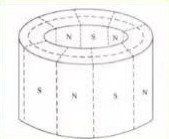
Radial Multi-pole Magnetization
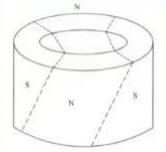
Skewed Multi-pole Magnetization
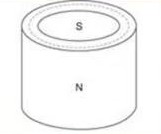
Radially Oriented Magnetization
Comprehensive Classification System of Radially Oriented Magnet Rings
Radially oriented magnet rings can be systematically categorized from three core dimensions:
Orientation Process
Mainly divided into magnetic field orientation (for sintering/bonding processes) and pressure orientation (for hot pressing/hot deformation processes).
Material System
Primarily covering ferrite permanent magnet rings and rare-earth permanent magnet rings (represented by samarium-cobalt and neodymium-iron-boron). Among these, sintered or hot-pressed/hot-deformed neodymium-iron-boron magnet rings deliver the highest overall magnetic performance.
Structural Morphology
The structure is commonly classified by the inner-to-outer diameter ratio (K value):Thick-wall rings: K < 0.7; Thin-wall rings: K > 0.9
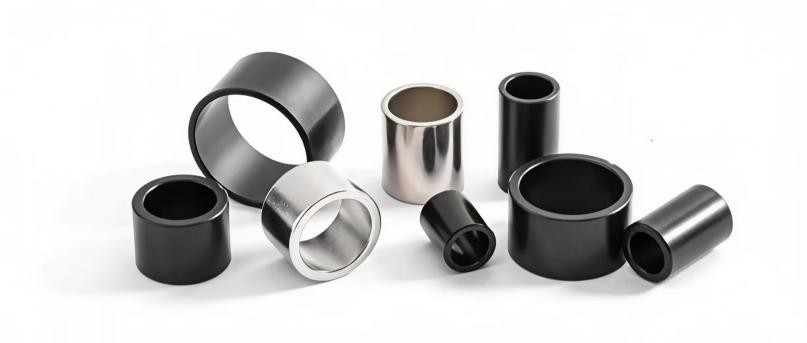
Classification by Permanent Magnet Materials
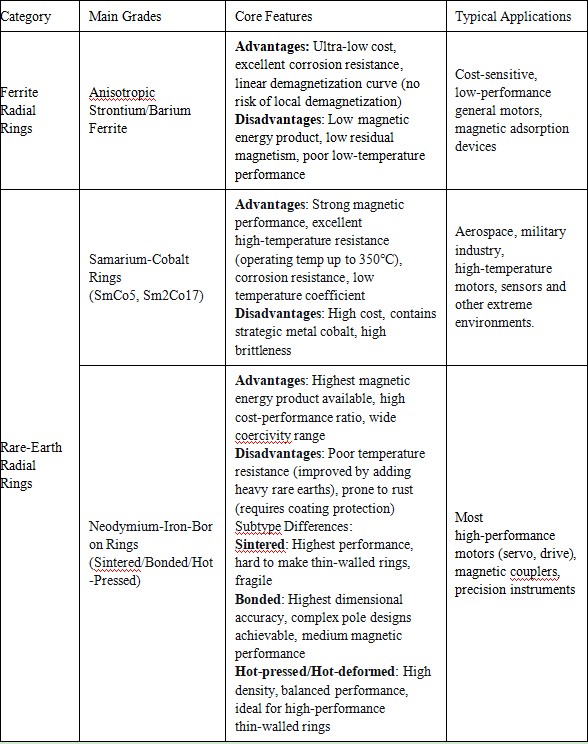
Achievable Sizes of Radially Oriented Magnet Rings Indirectly Affect Costs and Qualification Rates
Bonded Radial Rings:Offer the highest dimensional flexibility.
Theoretically, they can be produced with outer diameters ranging from millimeters to hundreds of millimeters. They also support extremely thin walls (under 1 mm) or custom-shaped structures, making them the top choice for customized, complex designs.
Hot-Pressed/Hot-Deformed Radial Rings:Specialize in high-performance thin-walled components.
Their manufacturing process is ideal for small-diameter rings (typically <Φ30 mm) with thin walls (typically <3 mm), which maximizes the material’s strengths of high density and high orientation. These rings are widely used in micro precision motors.
Sintered Radial Rings:Have great size potential, but cost efficiency drives the market.
Technically, their outer diameter can exceed 200 mm, and the wall thickness can be more than 5 mm. However, large-size blanks are prone to deformation and cracking during the sintering process, and the raw material and processing costs are also higher. This significantly reduces the yield rate. Therefore, the cost-effective commercial sintered radial rings on the market generally have an outer diameter limited to below 100 mm.
Saint Langma-- Your trusted partner for custom magnetic solutions. We deliver professional, tailored designs and unbeatable pre & after-sales service, ensuring we meet every single one of your diverse needs.
Search
Categories List
Please give us a message
Beijing Saint Langma Magnetic Technology Co.,Ltd